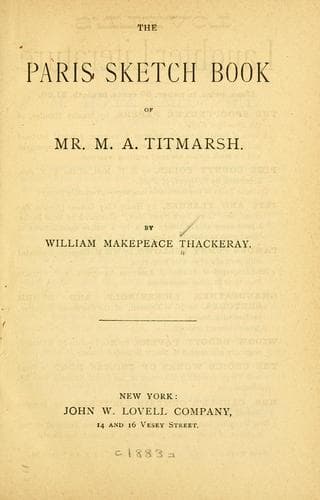
The Paris Sketch Book of Mr. M. A. TitmarshThackeray, William Makepeace
General
The Paris Sketch Book of Mr. M. A. Titmarsh
Thackeray, William Makepeace
Paris (France) -- Description and travel
“In Russia it is to the imperial dynasty that is owing all the vast
progress which, in a century and a half, has rescued that empire from
barbarism. The imperial power must contend against all the ancient
prejudices of our old Europe: it must centralize, as far as possible,
all the powers of the state in the hands of one person, in order to
destroy the abuses which the feudal and communal franchises have served
to perpetuate. The last alone can hope to receive from it the
improvements which it expects.
“But thou, France of Henry IV., of Louis XIV., of Carnot, of
Napoleon—thou, who wert always for the west of Europe the source of
progress, who possessest in thyself the two great pillars of empire,
the genius for the arts of peace and the genius of war—hast thou no
further mission to fulfil? Wilt thou never cease to waste thy force and
energies in intestine struggles? No; such cannot be thy destiny: the
day will soon come, when, to govern thee, it will be necessary to
understand that thy part is to place in all treaties thy sword of
Brennus on the side of civilization.”
These are the conclusions of the Prince’s remarks upon governments in
general; and it must be supposed that the reader is very little wiser
at the end than at the beginning. But two governments in the world
fulfil their mission: the one government, which is no government; the
other, which is a despotism. The duty of France is IN ALL TREATIES to
place her sword of Brennus in the scale of civilization. Without
quarrelling with the somewhat confused language of the latter
proposition, may we ask what, in heaven’s name, is the meaning of all
the three? What is this épée de Brennus? and how is France to use it?
Where is the great source of political truth, from which, flowing pure,
we trace American republicanism in one stream, Russian despotism in
another? Vastly prosperous is the great republic, if you will: if
dollars and cents constitute happiness, there is plenty for all: but
can any one, who has read of the American doings in the late frontier
troubles, and the daily disputes on the slave question, praise the
GOVERNMENT of the States?—a Government which dares not punish homicide
or arson performed before its very eyes, and which the pirates of Texas
and the pirates of Canada can brave at their will? There is no
government, but a prosperous anarchy; as the Prince’s other favorite
government is a prosperous slavery. What, then, is to be the épée de
Brennus government? Is it to be a mixture of the two? “Society,” writes
the Prince, axiomatically, “contains in itself two principles—the one
of progress and immortality, the other of disease and disorganization.”
No doubt; and as the one tends towards liberty, so the other is only to
be cured by order: and then, with a singular felicity, Prince Louis
picks us out a couple of governments, in one of which the common
regulating power is as notoriously too weak, as it is in the other too
Public-domain text, read in full here on John Shaqi.
Reviews
Reviews
No reviews yet
Be the first to share your thoughts on this work.
Elsewhere in the archive
Join the Discussion
Join the discussion
Sign in to leave a comment or review.
Sign InorCreate an account