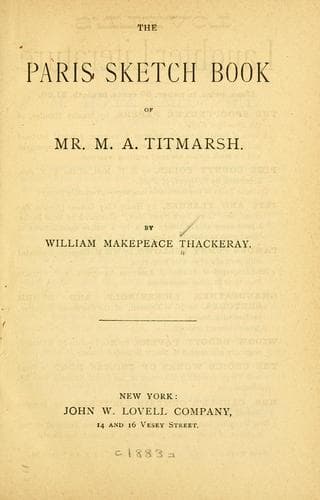
The Paris Sketch Book of Mr. M. A. TitmarshThackeray, William Makepeace
General
The Paris Sketch Book of Mr. M. A. Titmarsh
Thackeray, William Makepeace
Paris (France) -- Description and travel
“Liberty will follow the same march as the Christian religion. Armed
with death from the ancient society of Rome, it for a long while
excited the hatred and fear of the people. At last, by force of
martyrdoms and persecutions, the religion of Christ penetrated into the
conscience and the soul; it soon had kings and armies at its orders,
and Constantine and Charlemagne bore it triumphant throughout Europe.
Religion then laid down her arms of war. It laid open to all the
principles of peace and order which it contained; it became the prop of
Government, as it was the organizing element of society. Thus will it
be with liberty. In 1793 it frightened people and sovereigns alike;
then, having clothed itself in a milder garb, IT INSINUATED ITSELF
EVERYWHERE IN THE TRAIN OF OUR BATTALIONS. In 1815 all parties adopted
its flag, and armed themselves with its moral force—covered themselves
with its colors. The adoption was not sincere, and liberty was soon
obliged to reassume its warlike accoutrements. With the contest their
fears returned. Let us hope that they will soon cease, and that liberty
will soon resume her peaceful standards, to quit them no more.
“The Emperor Napoleon contributed more than any one else towards
accelerating the reign of liberty, by saving the moral influence of the
revolution, and diminishing the fears which it imposed. Without the
Consulate and the Empire, the revolution would have been only a grand
drama, leaving grand revolutions but no traces: the revolution would
have been drowned in the counter-revolution. The contrary, however, was
the case. Napoleon rooted the revolution in France, and introduced,
throughout Europe, the principal benefits of the crisis of 1789. To use
his own words, ‘He purified the revolution, he confirmed kings, and
ennobled people.’ He purified the revolution, in separating the truths
which it contained from the passions that, during its delirium,
disfigured it. He ennobled the people in giving them the consciousness
of their force, and those institutions which raise men in their own
eyes. The Emperor may be considered as the Messiah of the new ideas;
for—and we must confess it—in the moments immediately succeeding a
social revolution, it is not so essential to put rigidly into practice
all the propositions resulting from the new theory, but to become
master of the regenerative genius, to identify one’s self with the
sentiments of the people, and boldly to direct them towards the desired
point. To accomplish such a task YOUR FIBRE SHOULD RESPOND TO THAT OF
THE PEOPLE, as the Emperor said; you should feel like it, your
interests should be so intimately raised with its own, that you should
vanquish or fall together.”
Public-domain text, read in full here on John Shaqi.
Reviews
Reviews
No reviews yet
Be the first to share your thoughts on this work.
Elsewhere in the archive
Join the Discussion
Join the discussion
Sign in to leave a comment or review.
Sign InorCreate an account