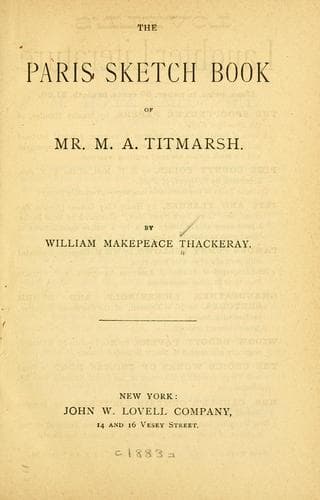
The Paris Sketch Book of Mr. M. A. TitmarshThackeray, William Makepeace
General
The Paris Sketch Book of Mr. M. A. Titmarsh
Thackeray, William Makepeace
Paris (France) -- Description and travel
“Mademoiselle Marie,” he said, “is perfectly correct in her surmise. I
do not want the life of this poor drivelling old man: my intentions are
much more peaceable, be assured. It rests entirely with this
accomplished young lady (whose spirit I like, and whose ready wit I
admire), whether the business between us shall be a matter of love or
death. I humbly offer myself, citizen Ancel, as a candidate for the
hand of your charming daughter. Her goodness, her beauty, and the large
fortune which I know you intend to give her, would render her a
desirable match for the proudest man in the republic, and, I am sure,
would make me the happiest.”
“This must be a jest, Monsieur Schneider,” said Mary, trembling, and
turning deadly pale: “you cannot mean this; you do not know me: you
never heard of me until to-day.”
“Pardon me, belle dame,” replied he; “your cousin Pierre has often
talked to me of your virtues; indeed, it was by his special suggestion
that I made the visit.”
“It is false!—it is a base and cowardly lie!” exclaimed she (for the
young lady’s courage was up),—“Pierre never could have forgotten
himself and me so as to offer me to one like you. You come here with a
lie on your lips—a lie against my father, to swear his life away,
against my dear cousin’s honor and love. It is useless now to deny it:
father, I love Pierre Ancel; I will marry no other but him—no, though
our last penny were paid to this man as the price of our freedom.”
Schneider’s only reply to this was a call to his friend Gregoire.
“Send down to the village for the maire and some gendarmes; and tell
your people to make ready.”
“Shall I put THE MACHINE up?” shouted he of the sentimental turn.
“You hear him,” said Schneider; “Marie Ancel, you may decide the fate
of your father. I shall return in a few hours,” concluded he, “and will
then beg to know your decision.”
The advocate of the rights of man then left the apartment, and left the
family, as you may imagine, in no very pleasant mood.
Old uncle Jacob, during the few minutes which had elapsed in the
enactment of this strange scene, sat staring wildly at Schneider, and
holding Mary on his knees: the poor little thing had fled to him for
protection, and not to her father, who was kneeling almost senseless at
the window, gazing at the executioner and his hideous preparations. The
instinct of the poor girl had not failed her; she knew that Jacob was
her only protector, if not of her life—heaven bless him!—of her honor.
“Indeed,” the old man said, in a stout voice, “this must never be, my
dearest child—you must not marry this man. If it be the will of
Providence that we fall, we shall have at least the thought to console
us that we die innocent. Any man in France at a time like this, would
be a coward and traitor if he feared to meet the fate of the thousand
brave and good who have preceded us.”
Public-domain text, read in full here on John Shaqi.
Reviews
Reviews
No reviews yet
Be the first to share your thoughts on this work.
Elsewhere in the archive
Join the Discussion
Join the discussion
Sign in to leave a comment or review.
Sign InorCreate an account