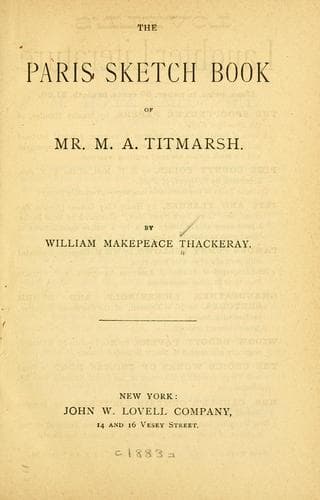
The Paris Sketch Book of Mr. M. A. TitmarshThackeray, William Makepeace
General
The Paris Sketch Book of Mr. M. A. Titmarsh
Thackeray, William Makepeace
Paris (France) -- Description and travel
A number of men and women, singing epithalamiums, and dressed in some
absurd imitation of Roman costume, a troop of soldiers and gendarmerie,
and an immense crowd of the badauds of Strasburg, were surrounding a
carriage which then entered the court of the mayoralty. In this
carriage, great God! I saw my dear Mary, and Schneider by her side. The
truth instantly came upon me: the reason for Schneider’s keen inquiries
and my abrupt dismissal; but I could not believe that Mary was false to
me. I had only to look in her face, white and rigid as marble, to see
that this proposed marriage was not with her consent.
I fell back in the crowd as the procession entered the great room in
which I was, and hid my face in my hands: I could not look upon her as
the wife of another,—upon her so long loved and truly—the saint of my
childhood—the pride and hope of my youth—torn from me for ever, and
delivered over to the unholy arms of the murderer who stood before me.
The door of St. Just’s private apartment opened, and he took his seat
at the table of mayoralty just as Schneider and his cortège arrived
before it.
Schneider then said that he came in before the authorities of the
Republic to espouse the citoyenne Marie Ancel.
“Is she a minor?” asked St. Just.
“She is a minor, but her father is here to give her away.”
“I am here,” said uncle Edward, coming eagerly forward and bowing.
“Edward Ancel, so please you, citizen representative. The worthy
citizen Schneider has done me the honor of marrying into my family.”
“But my father has not told you the terms of the marriage,” said Mary,
interrupting him, in a loud, clear voice.
Here Schneider seized her hand, and endeavored to prevent her from
speaking. Her father turned pale, and cried, “Stop, Mary, stop! For
heaven’s sake, remember your poor old father’s danger!”
“Sir, may I speak?”
“Let the young woman speak,” said St. Just, “if she have a desire to
talk.” He did not suspect what would be the purport of her story.
Public-domain text, read in full here on John Shaqi.
Reviews
Reviews
No reviews yet
Be the first to share your thoughts on this work.
Elsewhere in the archive
Join the Discussion
Join the discussion
Sign in to leave a comment or review.
Sign InorCreate an account