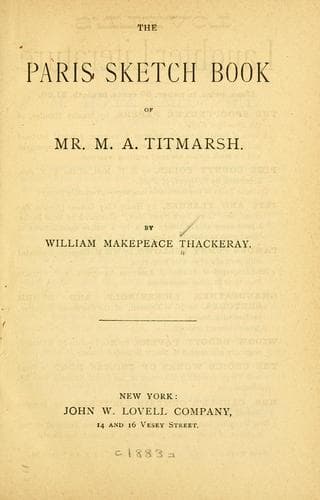
The Paris Sketch Book of Mr. M. A. TitmarshThackeray, William Makepeace
General
The Paris Sketch Book of Mr. M. A. Titmarsh
Thackeray, William Makepeace
Paris (France) -- Description and travel
Schneider was left for several hours exposed to the mockery and insults
of the mob; he was then, according to his sentence, marched on to
Paris, where it is probable that he would have escaped death, but for
his own fault. He was left for some time in prison, quite unnoticed,
perhaps forgotten: day by day fresh victims were carried to the
scaffold, and yet the Alsacian tribune remained alive; at last, by the
mediation of one of his friends, a long petition was presented to
Robespierre, stating his services and his innocence, and demanding his
freedom. The reply to this was an order for his instant execution: the
wretch died in the last days of Robespierre’s reign. His comrade, St.
Just, followed him, as you know; but Edward Ancel had been released
before this, for the action of my brave Mary had created a strong
feeling in his favor.
“And Mary?” said I.
Here a stout and smiling old lady entered the Captain’s little room:
she was leaning on the arm of a military-looking man of some forty
years, and followed by a number of noisy, rosy children.
“This is Mary Ancel,” said the Captain, “and I am Captain Pierre, and
yonder is the Colonel, my son; and you see us here assembled in force,
for it is the fête of little Jacob yonder, whose brothers and sisters
have all come from their schools to dance at his birthday.”
BEATRICE MERGER.
Beatrice Merger, whose name might figure at the head of one of Mr.
Colburn’s politest romances—so smooth and aristocratic does it sound—is
no heroine, except of her own simple history; she is not a fashionable
French Countess, nor even a victim of the Revolution.
She is a stout, sturdy girl of two-and-twenty, with a face beaming with
good nature, and marked dreadfully by smallpox; and a pair of black
eyes, which might have done some execution had they been placed in a
smoother face. Beatrice’s station in society is not very exalted; she
is a servant of all-work: she will dress your wife, your dinner, your
children; she does beefsteaks and plain work; she makes beds, blacks
boots, and waits at table;—such, at least, were the offices which she
performed in the fashionable establishment of the writer of this book:
perhaps her history may not inaptly occupy a few pages of it.
“My father died,” said Beatrice, “about six years since, and left my
poor mother with little else but a small cottage and a strip of land,
and four children too young to work. It was hard enough in my father’s
time to supply so many little mouths with food; and how was a poor
widowed woman to provide for them now, who had neither the strength nor
the opportunity for labor?
Public-domain text, read in full here on John Shaqi.
Reviews
Reviews
No reviews yet
Be the first to share your thoughts on this work.
Elsewhere in the archive
Join the Discussion
Join the discussion
Sign in to leave a comment or review.
Sign InorCreate an account