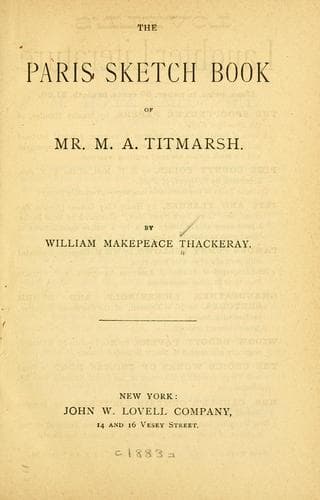
The Paris Sketch Book of Mr. M. A. TitmarshThackeray, William Makepeace
General
The Paris Sketch Book of Mr. M. A. Titmarsh
Thackeray, William Makepeace
Paris (France) -- Description and travel
“So, every Saturday, when work was over, I had thirty sous to carry
home to mother; and tired though I was, I walked merrily the two
leagues to our village, to see her again. On the road there was a great
wood to pass through, and this frightened me; for if a thief should
come and rob me of my whole week’s earnings, what could a poor lone
girl do to help herself? But I found a remedy for this too, and no
thieves ever came near me; I used to begin saying my prayers as I
entered the forest, and never stopped until I was safe at home; and
safe I always arrived, with my thirty sons in my pocket. Ah! you may be
sure, Sunday was a merry day for us all.”
This is the whole of Beatrice’s history which is worthy of publication;
the rest of it only relates to her arrival in Paris, and the various
masters and mistresses whom she there had the honor to serve. As soon
as she enters the capital the romance disappears, and the poor girl’s
sufferings and privations luckily vanish with it. Beatrice has got now
warm gowns, and stout shoes, and plenty of good food. She has had her
little brother from Picardy; clothed, fed, and educated him: that young
gentleman is now a carpenter, and an honor to his profession. Madame
Merger is in easy circumstances, and receives, yearly, fifty francs
from her daughter. To crown all, Mademoiselle Beatrice herself is a
funded proprietor, and consulted the writer of this biography as to the
best method of laying out a capital of two hundred francs, which is the
present amount of her fortune.
God bless her! she is richer than his Grace the Duke of Devonshire;
and, I dare say, has, in her humble walk, been more virtuous and more
happy than all the dukes in the realm.
It is, indeed, for the benefit of dukes and such great people (who, I
make no doubt, have long since ordered copies of these Sketches), that
poor little Beatrice’s story has been indited. Certain it is, that the
young woman would never have been immortalized in this way, but for the
good which her betters may derive from her example. If your ladyship
will but reflect a little, after boasting of the sums which you spend
in charity; the beef and blankets which you dole out at Christmas; the
poonah-painting which you execute for fancy fairs; the long, long
sermons which you listen to at St. George’s, the whole year
through;—your ladyship, I say, will allow that, although perfectly
meritorious in your line, as a patroness of the Church of England, of
Almack’s, and of the Lying-in Asylum, yours is but a paltry sphere of
virtue, a pitiful attempt at benevolence, and that this honest
servant-girl puts you to shame! And you, my Lord Bishop: do you, out of
your six sous a day, give away five to support your flock and family?
Would you drop a single coach-horse (I do not say, A DINNER, for such a
notion is monstrous, in one of your lordship’s degree), to feed any one
of the starving children of your lordship’s mother—the Church?
Public-domain text, read in full here on John Shaqi.
Reviews
Reviews
No reviews yet
Be the first to share your thoughts on this work.
Elsewhere in the archive
Join the Discussion
Join the discussion
Sign in to leave a comment or review.
Sign InorCreate an account