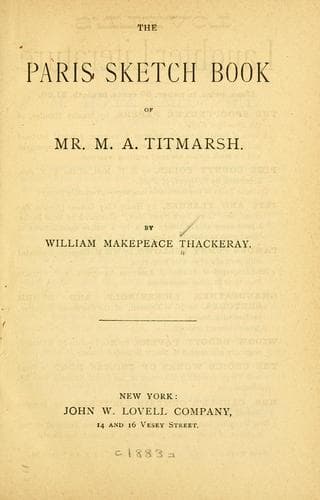
The Paris Sketch Book of Mr. M. A. TitmarshThackeray, William Makepeace
General
The Paris Sketch Book of Mr. M. A. Titmarsh
Thackeray, William Makepeace
Paris (France) -- Description and travel
One day, it is said, that Aloys was called upon to write—rather a
humble composition for an author and artist—a washing-bill. He had no
paper at hand, and so he wrote out the bill with some of his
newly-invented ink upon one of his Kelheim stones. Some time afterwards
he thought he would try and take an IMPRESSION of his washing-bill: he
did, and succeeded. Such is the story, which the reader most likely
knows very well; and having alluded to the origin of the art, we shall
not follow the stream through its windings and enlargement after it
issued from the little parent rock, or fill our pages with the rest of
the pedigree. Senefelder invented Lithography. His invention has not
made so much noise and larum in the world as some others, which have an
origin quite as humble and unromantic; but it is one to which we owe no
small profit, and a great deal of pleasure; and, as such, we are bound
to speak of it with all gratitude and respect. The schoolmaster, who is
now abroad, has taught us, in our youth, how the cultivation of art
“emollit mores nec sinit esse”—(it is needless to finish the
quotation); and Lithography has been, to our thinking, the very best
ally that art ever had; the best friend of the artist, allowing him to
produce rapidly multiplied and authentic copies of his own works
(without trusting to the tedious and expensive assistance of the
engraver); and the best friend to the people likewise, who have means
of purchasing these cheap and beautiful productions, and thus having
their ideas “mollified” and their manners “feros” no more.
With ourselves, among whom money is plenty, enterprise so great, and
everything matter of commercial speculation, Lithography has not been
so much practised as wood or steel engraving; which, by the aid of
great original capital and spread of sale, are able more than to
compete with the art of drawing on stone. The two former may be called
art done by MACHINERY. We confess to a prejudice in favor of the honest
work of HAND, in matters of art, and prefer the rough workmanship of
the painter to the smooth copies of his performances which are
produced, for the most part, on the wood-block or the steel-plate.
Public-domain text, read in full here on John Shaqi.
Reviews
Reviews
No reviews yet
Be the first to share your thoughts on this work.
Elsewhere in the archive
Join the Discussion
Join the discussion
Sign in to leave a comment or review.
Sign InorCreate an account