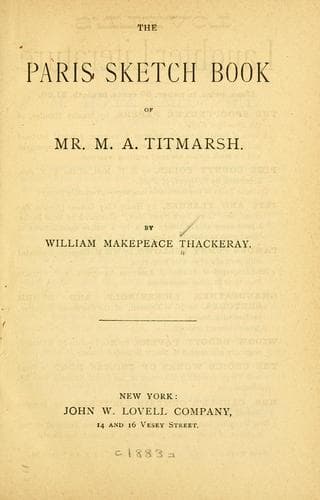
The Paris Sketch Book of Mr. M. A. TitmarshThackeray, William Makepeace
General
The Paris Sketch Book of Mr. M. A. Titmarsh
Thackeray, William Makepeace
Paris (France) -- Description and travel
We are not going to trace the history of the rise and progress of art
in France; our business, at present, is only to speak of one branch of
art in that country—lithographic designs, and those chiefly of a
humorous character. A history of French caricature was published in
Paris, two or three years back, illustrated by numerous copies of
designs, from the time of Henry III. to our own day. We can only speak
of this work from memory, having been unable, in London, to procure the
sight of a copy; but our impression, at the time we saw the collection,
was as unfavorable as could possibly be: nothing could be more meagre
than the wit, or poorer than the execution, of the whole set of
drawings. Under the Empire, art, as may be imagined, was at a very low
ebb; and, aping the Government of the day, and catering to the national
taste and vanity, it was a kind of tawdry caricature of the sublime; of
which the pictures of David and Girodet, and almost the entire
collection now at the Luxembourg Palace, will give pretty fair
examples. Swollen, distorted, unnatural, the painting was something
like the politics of those days; with force in it, nevertheless, and
something of grandeur, that will exist in spite of taste, and is born
of energetic will. A man, disposed to write comparisons of characters,
might, for instance, find some striking analogies between mountebank
Murat, with his irresistible bravery and horsemanship, who was a kind
of mixture of Dugueselin and Ducrow, and Mountebank David, a fierce,
powerful painter and genius, whose idea of beauty and sublimity seemed
to have been gained from the bloody melodramas on the Boulevard. Both,
however, were great in their way, and were worshipped as gods, in those
heathen times of false belief and hero-worship.
As for poor caricature and freedom of the press, they, like the
rightful princess in a fairy tale, with the merry fantastic dwarf, her
attendant, were entirely in the power of the giant who ruled the land.
The Princess Press was so closely watched and guarded (with some little
show, nevertheless, of respect for her rank), that she dared not utter
a word of her own thoughts; and, for poor Caricature, he was gagged,
and put out of the way altogether: imprisoned as completely as ever
Asmodeus was in his phial.
How the Press and her attendant fared in succeeding reigns, is well
known; their condition was little bettered by the downfall of Napoleon:
with the accession of Charles X. they were more oppressed even than
before—more than they could bear; for so hard were they pressed, that,
as one has seen when sailors are working a capstan, back of a sudden
the bars flew, knocking to the earth the men who were endeavoring to
work them. The Revolution came, and up sprung Caricature in France; all
sorts of fierce epigrams were discharged at the flying monarch, and
speedily were prepared, too, for the new one.
Public-domain text, read in full here on John Shaqi.
Reviews
Reviews
No reviews yet
Be the first to share your thoughts on this work.
Elsewhere in the archive
Join the Discussion
Join the discussion
Sign in to leave a comment or review.
Sign InorCreate an account