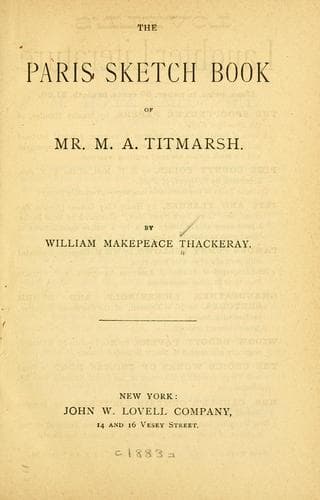
The Paris Sketch Book of Mr. M. A. TitmarshThackeray, William Makepeace
General
The Paris Sketch Book of Mr. M. A. Titmarsh
Thackeray, William Makepeace
Paris (France) -- Description and travel
At last came the famous September laws: the freedom of the Press,
which, from August, 1830, was to be “désormais une vérité,” was calmly
strangled by the Monarch who had gained his crown for his supposed
championship of it; by his Ministers, some of whom had been stout
Republicans on paper but a few years before; and by the Chamber, which,
such is the blessed constitution of French elections, will generally
vote, unvote, revote in any way the Government wishes. With a wondrous
union, and happy forgetfulness of principle, monarch, ministers, and
deputies issued the restriction laws; the Press was sent to prison; as
for the poor dear Caricature, it was fairly murdered. No more political
satires appear now, and “through the eye, correct the heart;” no more
poires ripen on the walls of the metropolis; Philipon’s political
occupation is gone.
But there is always food for satire; and the French caricaturists,
being no longer allowed to hold up to ridicule and reprobation the King
and the deputies, have found no lack of subjects for the pencil in the
ridicules and rascalities of common life. We have said that public
decency is greater amongst the French than amongst us, which, to some
of our readers, may appear paradoxical; but we shall not attempt to
argue that, in private roguery, our neighbors are not our equals. The
procès of Gisquet, which has appeared lately in the papers, shows how
deep the demoralization must be, and how a Government, based itself on
dishonesty (a tyranny, that is, under the title and fiction of a
democracy,) must practise and admit corruption in its own and in its
agents’ dealings with the nation. Accordingly, of cheating contracts,
of ministers dabbling with the funds, or extracting underhand profits
for the granting of unjust privileges and monopolies,—of grasping,
envious police restrictions, which destroy the freedom, and, with it,
the integrity of commerce,—those who like to examine such details may
find plenty in French history: the whole French finance system has been
a swindle from the days of Luvois, or Law, down to the present time.
The Government swindles the public, and the small traders swindle their
customers, on the authority and example of the superior powers. Hence
the art of roguery, under such high patronage, maintains in France a
noble front of impudence, and a fine audacious openness, which it does
not wear in our country.
Among the various characters of roguery which the French satirists have
amused themselves by depicting, there is one of which the GREATNESS
(using the word in the sense which Mr. Jonathan Wild gave to it) so far
exceeds that of all others, embracing, as it does, all in turn, that it
has come to be considered the type of roguery in general; and now, just
as all the political squibs were made to come of old from the lips of
Pasquin, all the reflections on the prevailing cant, knavery, quackery,
humbug, are put into the mouth of Monsieur Robert Macaire.
Public-domain text, read in full here on John Shaqi.
Reviews
Reviews
No reviews yet
Be the first to share your thoughts on this work.
Elsewhere in the archive
Join the Discussion
Join the discussion
Sign in to leave a comment or review.
Sign InorCreate an account