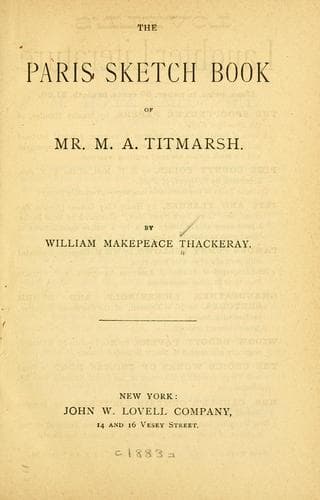
The Paris Sketch Book of Mr. M. A. TitmarshThackeray, William Makepeace
General
The Paris Sketch Book of Mr. M. A. Titmarsh
Thackeray, William Makepeace
Paris (France) -- Description and travel
Bertrand is the simple recipient of Macaire’s jokes, and makes
vicarious atonement for his crimes, acting, in fact, the part which
pantaloon performs in the pantomime, who is entirely under the fatal
influence of clown. He is quite as much a rogue as that gentleman, but
he has not his genius and courage. So, in pantomimes, (it may,
doubtless, have been remarked by the reader,) clown always leaps first,
pantaloon following after, more clumsily and timidly than his bold and
accomplished friend and guide. Whatever blows are destined for clown,
fall, by some means of ill-luck, upon the pate of pantaloon: whenever
the clown robs, the stolen articles are sure to be found in his
companion’s pocket; and thus exactly Robert Macaire and his companion
Bertrand are made to go through the world; both swindlers, but the one
more accomplished than the other. Both robbing all the world, and
Robert robbing his friend, and, in the event of danger, leaving him
faithfully in the lurch. There is, in the two characters, some
grotesque good for the spectator—a kind of “Beggars’ Opera” moral.
Ever since Robert, with his dandified rags and airs, his cane and
snuff-box, and Bertrand with torn surtout and all-absorbing pocket,
have appeared on the stage, they have been popular with the Parisians;
and with these two types of clever and stupid knavery, M. Philipon and
his companion Daumier have created a world of pleasant satire upon all
the prevailing abuses of the day.
Almost the first figure that these audacious caricaturists dared to
depict was a political one: in Macaire’s red breeches and tattered coat
appeared no less a personage than the King himself—the old Poire—in a
country of humbugs and swindlers the facile princeps; fit to govern, as
he is deeper than all the rogues in his dominions. Bertrand was
opposite to him, and having listened with delight and reverence to some
tale of knavery truly royal, was exclaiming with a look and voice
expressive of the most intense admiration, “AH VIEUX BLAGEUR! va!”—the
word blague is untranslatable—it means FRENCH humbug as distinct from
all other; and only those who know the value of an epigram in France,
an epigram so wonderfully just, a little word so curiously
comprehensive, can fancy the kind of rage and rapture with which it was
received. It was a blow that shook the whole dynasty. Thersites had
there given such a wound to Ajax, as Hector in arms could scarcely have
inflicted: a blow sufficient almost to create the madness to which the
fabulous hero of Homer and Ovid fell a prey.
Public-domain text, read in full here on John Shaqi.
Reviews
Reviews
No reviews yet
Be the first to share your thoughts on this work.
Elsewhere in the archive
Join the Discussion
Join the discussion
Sign in to leave a comment or review.
Sign InorCreate an account