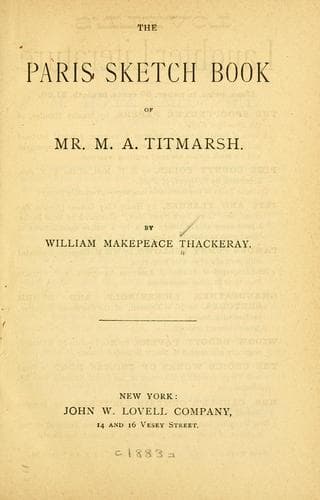
The Paris Sketch Book of Mr. M. A. TitmarshThackeray, William Makepeace
General
The Paris Sketch Book of Mr. M. A. Titmarsh
Thackeray, William Makepeace
Paris (France) -- Description and travel
In the meantime Robert and his friend have been furnishing the designs
that we have before us, and of which perhaps the reader will be edified
by a brief description. We are not, to be sure, to judge of the French
nation by M. Macaire, any more than we are to judge of our own national
morals in the last century by such a book as the “Beggars’ Opera;” but
upon the morals and the national manners, works of satire afford a
world of light that one would in vain look for in regular books of
history. Doctor Smollett would have blushed to devote any considerable
portion of his pages to a discussion of the acts and character of Mr.
Jonathan Wild, such a figure being hardly admissible among the
dignified personages who usually push all others out from the
possession of the historical page; but a chapter of that gentleman’s
memoirs, as they are recorded in that exemplary recueil—the “Newgate
Calendar;” nay, a canto of the great comic epic (involving many fables,
and containing much exaggeration, but still having the seeds of truth)
which the satirical poet of those days wrote in celebration of him—we
mean Fielding’s “History of Jonathan Wild the Great”—does seem to us to
give a more curious picture of the manners of those times than any
recognized history of them. At the close of his history of George II.,
Smollett condescends to give a short chapter on Literature and Manners.
He speaks of Glover’s “Leonidas,” Cibber’s “Careless Husband,” the
poems of Mason, Gray, the two Whiteheads, “the nervous style, extensive
erudition, and superior sense of a Corke; the delicate taste, the
polished muse, and tender feeling of a Lyttelton.” “King,” he says,
“shone unrivalled in Roman eloquence, the female sex distinguished
themselves by their taste and ingenuity. Miss Carter rivalled the
celebrated Dacier in learning and critical knowledge; Mrs. Lennox
signalized herself by many successful efforts of genius both in poetry
and prose; and Miss Reid excelled the celebrated Rosalba in
portrait-painting, both in miniature and at large, in oil as well as in
crayons. The genius of Cervantes was transferred into the novels of
Fielding, who painted the characters and ridiculed the follies of life
with equal strength, humor, and propriety. The field of history and
biography was cultivated by many writers of ability, among whom we
distinguish the copious Guthrie, the circumstantial Ralph, the
laborious Carte, the learned and elegant Robertson, and above all, the
ingenious, penetrating, and comprehensive Hume,” &c. &c. We will quote
no more of the passage. Could a man in the best humor sit down to write
a graver satire? Who cares for the tender muse of Lyttelton? Who knows
the signal efforts of Mrs. Lennox’s genius? Who has seen the admirable
performances, in miniature and at large, in oil as well as in crayons,
of Miss Reid? Laborious Carte, and circumstantial Ralph, and copious
Guthrie, where are they, their works, and their reputation? Mrs.
Public-domain text, read in full here on John Shaqi.
Reviews
Reviews
No reviews yet
Be the first to share your thoughts on this work.
Elsewhere in the archive
Join the Discussion
Join the discussion
Sign in to leave a comment or review.
Sign InorCreate an account