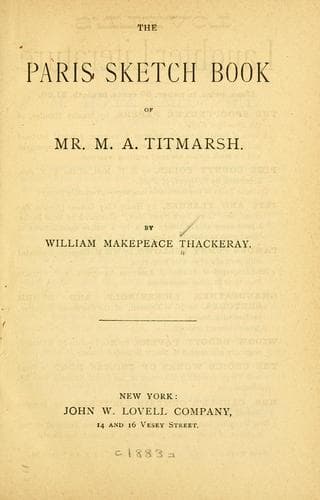
The Paris Sketch Book of Mr. M. A. TitmarshThackeray, William Makepeace
General
The Paris Sketch Book of Mr. M. A. Titmarsh
Thackeray, William Makepeace
Paris (France) -- Description and travel
“Not knowing, as yet, that his wife had been hit, he jumped out on one
side of the carriage, while Madame Peytel descended from the other; and
he fired a second pistol at his domestic, Louis Rey, whom he had just
recognized. Redoubling his pace, he came up with Rey, and struck him,
from behind, a blow with the hammer. Rey turned at this, and raised up
his arm to strike his master with the pistol which he had just
discharged at him; but Peytel, more quick than he, gave the domestic a
blow with the hammer, which felled him to the ground (he fell his face
forwards), and then Peytel, bestriding the body, despatched him,
although the brigand asked for mercy.
“He now began to think of his wife and ran back, calling out her name
repeatedly, and seeking for her, in vain, on both sides of the road.
Arrived at the bridge of Andert, he recognized his wife, stretched in a
field, covered with water, which bordered the Furans. This horrible
discovery had so much the more astonished him, because he had no idea,
until now, that his wife had been wounded: he endeavored to draw her
from the water; and it was only after considerable exertions that he
was enabled to do so, and to place her, with her face towards the
ground, on the side of the road. Supposing that, here, she would be
sheltered from any farther danger, and believing, as yet, that she was
only wounded, he determined to ask for help at a lone house, situated
on the road towards Rossillon; and at this instant he perceived,
without at all being able to explain how, that his horse had followed
him back to the spot, having turned back of its own accord, from the
road to Belley.
“The house at which he knocked was inhabited by two men, of the name of
Thannet, father and son, who opened the door to him, and whom he
entreated to come to his aid, saying that his wife had just been
assassinated by his servant. The elder Thannet approached to, and
examined the body, and told Peytel that it was quite dead; he and his
son took up the corpse, and placed it in the bottom of the carriage,
which they all mounted themselves, and pursued their route to Belley.
In order to do so, they had to pass by Rey’s body, on the road, which
Peytel wished to crush under the wheels of his carriage. It was to rob
him of 7,500 francs, said Peytel, that the attack had been made.”
Our friend, the Procureur’s Substitut, has dropped, here, the eloquent
and pathetic style altogether, and only gives the unlucky prisoner’s
narrative in the baldest and most unimaginative style. How is a jury to
listen to such a fellow? they ought to condemn him, if but for making
such an uninteresting statement. Why not have helped poor Peytel with
some of those rhetorical graces which have been so plentifully bestowed
in the opening part of the act of accusation? He might have said:—
Public-domain text, read in full here on John Shaqi.
Reviews
Reviews
No reviews yet
Be the first to share your thoughts on this work.
Elsewhere in the archive
Join the Discussion
Join the discussion
Sign in to leave a comment or review.
Sign InorCreate an account