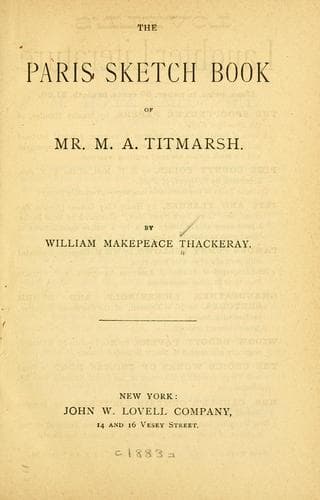
The Paris Sketch Book of Mr. M. A. TitmarshThackeray, William Makepeace
General
The Paris Sketch Book of Mr. M. A. Titmarsh
Thackeray, William Makepeace
Paris (France) -- Description and travel
There is the old classical drama, wellnigh dead, and full time too: old
tragedies, in which half a dozen characters appear, and spout sonorous
Alexandrines for half a dozen hours. The fair Rachel has been trying to
revive this genre, and to untomb Racine; but be not alarmed, Racine
will never come to life again, and cause audiences to weep as of yore.
Madame Rachel can only galvanize the corpse, not revivify it. Ancient
French tragedy, red-heeled, patched, and be-periwigged, lies in the
grave; and it is only the ghost of it that we see, which the fair
Jewess has raised. There are classical comedies in verse, too, wherein
the knavish valets, rakish heroes, stolid old guardians, and smart,
free-spoken serving-women, discourse in Alexandrines, as loud as the
Horaces or the Cid. An Englishman will seldom reconcile himself to the
roulement of the verses, and the painful recurrence of the rhymes; for
my part, I had rather go to Madame Saqui’s or see Deburau dancing on a
rope: his lines are quite as natural and poetical.
Then there is the comedy of the day, of which Monsieur Scribe is the
father. Good heavens! with what a number of gay colonels, smart widows,
and silly husbands has that gentleman peopled the play-books. How that
unfortunate seventh commandment has been maltreated by him and his
disciples. You will see four pieces, at the Gymnase, of a night; and so
sure as you see them, four husbands shall be wickedly used. When is
this joke to cease? Mon Dieu! Play-writers have handled it for about
two thousand years, and the public, like a great baby, must have the
tale repeated to it over and over again.
Finally, there is the Drama, that great monster which has sprung into
life of late years; and which is said, but I don’t believe a word of
it, to have Shakspeare for a father. If Monsieur Scribe’s plays may be
said to be so many ingenious examples how to break one commandment, the
drame is a grand and general chaos of them all; nay, several crimes are
added, not prohibited in the Decalogue, which was written before dramas
were. Of the drama, Victor Hugo and Dumas are the well-known and
respectable guardians. Every piece Victor Hugo has written, since
“Hernani,” has contained a monster—a delightful monster, saved by one
virtue. There is Triboulet, a foolish monster; Lucrèce Borgia, a
maternal monster; Mary Tudor, a religious monster; Monsieur Quasimodo,
a humpback monster; and others, that might be named, whose
monstrosities we are induced to pardon—nay, admiringly to
witness—because they are agreeably mingled with some exquisite display
of affection. And, as the great Hugo has one monster to each play, the
great Dumas has, ordinarily, half a dozen, to whom murder is nothing;
common intrigue, and simple breakage of the before-mentioned
commandment, nothing; but who live and move in a vast, delightful
complication of crime, that cannot be easily conceived in England, much
less described.
Public-domain text, read in full here on John Shaqi.
Reviews
Reviews
No reviews yet
Be the first to share your thoughts on this work.
Elsewhere in the archive
Join the Discussion
Join the discussion
Sign in to leave a comment or review.
Sign InorCreate an account