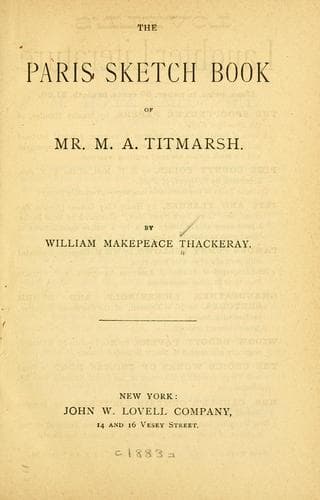
The Paris Sketch Book of Mr. M. A. TitmarshThackeray, William Makepeace
General
The Paris Sketch Book of Mr. M. A. Titmarsh
Thackeray, William Makepeace
Paris (France) -- Description and travel
“STELLA. MAGDALEN.”
Here the translator must pause—having no inclination to enter “the
tabernacle,” in company with such a spotless high-priest as Monsieur
Dumas.
Something “tabernacular” may be found in Dumas’s famous piece of “Don
Juan de Marana.” The poet has laid the scene of his play in a vast
number of places: in heaven (where we have the Virgin Mary and little
angels, in blue, swinging censers before her!)—on earth, under the
earth, and in a place still lower, but not mentionable to ears polite;
and the plot, as it appears from a dialogue between a good and a bad
angel, with which the play commences, turns upon a contest between
these two worthies for the possession of the soul of a member of the
family of Marana.
“Don Juan de Marana” not only resembles his namesake, celebrated by
Mozart and Molière, in his peculiar successes among the ladies, but
possesses further qualities which render his character eminently
fitting for stage representation: he unites the virtues of Lovelace and
Lacenaire; he blasphemes upon all occasions; he murders, at the
slightest provocation, and without the most trifling remorse; he
overcomes ladies of rigid virtue, ladies of easy virtue, and ladies of
no virtue at all; and the poet, inspired by the contemplation of such a
character, has depicted his hero’s adventures and conversation with
wonderful feeling and truth.
The first act of the play contains a half-dozen of murders and
intrigues; which would have sufficed humbler genius than M. Dumas’s,
for the completion of, at least, half a dozen tragedies. In the second
act our hero flogs his elder brother, and runs away with his
sister-in-law; in the third, he fights a duel with a rival, and kills
him: whereupon the mistress of his victim takes poison, and dies, in
great agonies, on the stage. In the fourth act, Don Juan, having
entered a church for the purpose of carrying off a nun, with whom he is
in love, is seized by the statue of one of the ladies whom he has
previously victimized, and made to behold the ghosts of all those
unfortunate persons whose deaths he has caused.
This is a most edifying spectacle. The ghosts rise solemnly, each in a
white sheet, preceded by a wax-candle; and, having declared their names
and qualities, call, in chorus, for vengeance upon Don Juan, as thus:—
DON SANDOVAL loquitur.
“I am Don Sandoval d’Ojedo. I played against Don Juan my fortune, the
tomb of my fathers, and the heart of my mistress;—I lost all: I played
against him my life, and I lost it. Vengeance against the murderer!
vengeance!”—(The candle goes out.)
THE CANDLE GOES OUT, and an angel descends—a flaming sword in his
hand—and asks: “Is there no voice in favor of Don Juan?” when lo! Don
Juan’s father (like one of those ingenious toys called
“Jack-in-the-box,”) jumps up from his coffin, and demands grace for his
son.
Public-domain text, read in full here on John Shaqi.
Reviews
Reviews
No reviews yet
Be the first to share your thoughts on this work.
Elsewhere in the archive
Join the Discussion
Join the discussion
Sign in to leave a comment or review.
Sign InorCreate an account