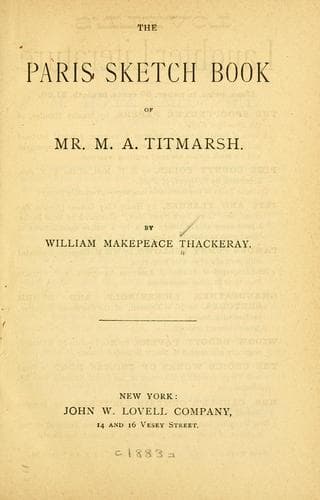
The Paris Sketch Book of Mr. M. A. TitmarshThackeray, William Makepeace
General
The Paris Sketch Book of Mr. M. A. Titmarsh
Thackeray, William Makepeace
Paris (France) -- Description and travel
The town is, certainly, the most moral of towns. You pass from the
railroad station through a long, lonely suburb, with dusty rows of
stunted trees on either side, and some few miserable beggars, idle
boys, and ragged old women under them. Behind the trees are gaunt,
mouldy houses; palaces once, where (in the days of the unbought grace
of life) the cheap defence of nations gambled, ogled, swindled,
intrigued; whence high-born duchesses used to issue, in old times, to
act as chambermaids to lovely Du Barri; and mighty princes rolled away,
in gilt caroches, hot for the honor of lighting his Majesty to bed, or
of presenting his stockings when he rose, or of holding his napkin when
he dined. Tailors, chandlers, tinmen, wretched hucksters, and
greengrocers, are now established in the mansions of the old peers;
small children are yelling at the doors, with mouths besmeared with
bread and treacle; damp rags are hanging out of every one of the
windows, steaming in the sun; oyster-shells, cabbage-stalks, broken
crockery, old papers, lie basking in the same cheerful light. A
solitary water-cart goes jingling down the wide pavement, and spirts a
feeble refreshment over the dusty, thirsty stones.
After pacing for some time through such dismal streets, we deboucher on
the grande place; and before us lies the palace dedicated to all the
glories of France. In the midst of the great lonely plain this famous
residence of King Louis looks low and mean.—Honored pile! Time was when
tall musketeers and gilded body-guards allowed none to pass the gate.
Fifty years ago, ten thousand drunken women from Paris broke through
the charm; and now a tattered commissioner will conduct you through it
for a penny, and lead you up to the sacred entrance of the palace.
We will not examine all the glories of France, as here they are
portrayed in pictures and marble: catalogues are written about these
miles of canvas, representing all the revolutionary battles, from Valmy
to Waterloo,—all the triumphs of Louis XIV.—all the mistresses of his
successor—and all the great men who have flourished since the French
empire began. Military heroes are most of these—fierce constables in
shining steel, marshals in voluminous wigs, and brave grenadiers in
bearskin caps; some dozens of whom gained crowns, principalities,
dukedoms; some hundreds, plunder and epaulets; some millions, death in
African sands, or in icy Russian plains, under the guidance, and for
the good, of that arch-hero, Napoleon. By far the greater part of “all
the glories” of France (as of most other countries) is made up of these
military men: and a fine satire it is on the cowardice of mankind, that
they pay such an extraordinary homage to the virtue called courage;
filling their history-books with tales about it, and nothing but it.
Public-domain text, read in full here on John Shaqi.
Reviews
Reviews
No reviews yet
Be the first to share your thoughts on this work.
Elsewhere in the archive
Join the Discussion
Join the discussion
Sign in to leave a comment or review.
Sign InorCreate an account