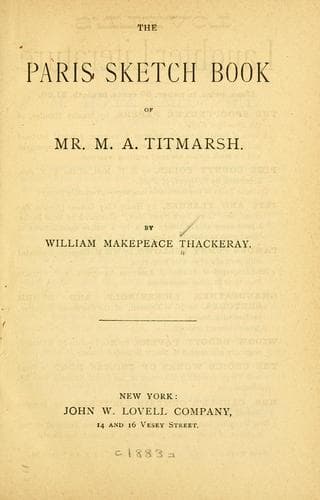
The Paris Sketch Book of Mr. M. A. TitmarshThackeray, William Makepeace
General
The Paris Sketch Book of Mr. M. A. Titmarsh
Thackeray, William Makepeace
Paris (France) -- Description and travel
He was lying as I have drawn him,[*] one hand on his breast, the other
falling towards the ground. There was an expression of perfect calm on
the face, and no mark of blood to stain the side towards the light. On
the other side, however, there was a great pool of black blood, and in
it the pistol; it looked more like a toy than a weapon to take away the
life of this vigorous young man. In his forehead, at the side, was a
small black wound; Jack’s life had passed through it; it was little
bigger than a mole.
* This refers to an illustrated edition of the work.
“Regardez un peu,” said the landlady, “messieurs, il m’a gâté trois
matelas, et il me doit quarante quatre francs.”
This was all his epitaph: he had spoiled three mattresses, and owed the
landlady four-and-forty francs. In the whole world there was not a soul
to love him or lament him. We, his friends, were looking at his body
more as an object of curiosity, watching it with a kind of interest
with which one follows the fifth act of a tragedy, and leaving it with
the same feeling with which one leaves the theatre when the play is
over and the curtain is down.
Beside Jack’s bed, on his little “table de nuit,” lay the remains of
his last meal, and an open letter, which we read. It was from one of
his suspicious acquaintances of former days, and ran thus:—
“Où es tu, cher Jack? why you not come and see me—tu me dois de
l’argent, entends tu?—un chapeau, une cachemire, a box of the Play.
Viens demain soir, je t’attendrai at eight o’clock, Passage des
Panoramas. My Sir is at his country.
“Adieu à demain.
“Fifine.
“Samedi.”
I shuddered as I walked through this very Passage des Panoramas, in the
evening. The girl was there, pacing to and fro, and looking in the
countenance of every passer-by, to recognize Attwood. “ADIEU À
DEMAIN!”—there was a dreadful meaning in the words, which the writer of
them little knew. “Adieu à demain!”—the morrow was come, and the soul
of the poor suicide was now in the presence of God. I dare not think of
his fate; for, except in the fact of his poverty and desperation, was
he worse than any of us, his companions, who had shared his debauches,
and marched with him up to the very brink of the grave?
There is but one more circumstance to relate regarding poor Jack—his
burial; it was of a piece with his death.
He was nailed into a paltry coffin and buried, at the expense of the
arrondissement, in a nook of the burial-place beyond the Barrière de
l’Etoile. They buried him at six o’clock, of a bitter winter’s morning,
and it was with difficulty that an English clergyman could be found to
read a service over his grave. The three men who have figured in this
history acted as Jack’s mourners; and as the ceremony was to take place
so early in the morning, these men sat up the night through, AND WERE
ALMOST DRUNK as they followed his coffin to its resting-place.
MORAL.
Public-domain text, read in full here on John Shaqi.
Reviews
Reviews
No reviews yet
Be the first to share your thoughts on this work.
Elsewhere in the archive
Join the Discussion
Join the discussion
Sign in to leave a comment or review.
Sign InorCreate an account