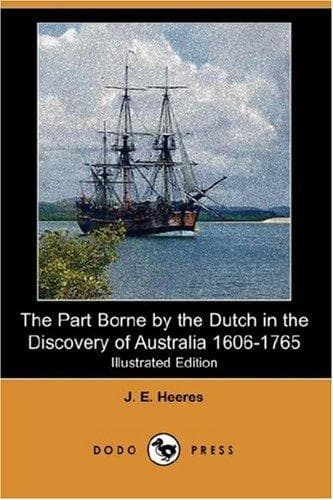
The Part Borne by the Dutch in the Discovery of Australia 1606-1765Heeres, J. E. (Jan Ernst)
History
The Part Borne by the Dutch in the Discovery of Australia 1606-1765
Heeres, J. E. (Jan Ernst)
Australia -- Discovery and exploration; Dutch -- Australia
You will set sail from Amboyna for Banda, in the name of God, With the
said yachts Cleen Amsterdam and Wesel on the first of April next, and
when you shall have arrived there, you will communicate these Orders and
Instructions to the Lord Governor Acoley.
Whom by these presents we enjoin to hand you in writing all such ampler
information as during his residence at Banda His Worship shall have
collected touching the {Page 65} lands and islands situated east of
Banda, at the same time letting you know where and in what islands His
Worship thinks some profit to be obtainable for the Company, or how
massoye bark and fitting men may be got, which order will in that case
have to be first executed.
And in case you should obtain no additional information, we would have
you set sail from Banda as speedily as possible for Arnhems- and Speults
land, situated between 9 and 13 degrees Southern Latitude, discovered
A.D. 1623, as you will more fully see from the appended chart; these are
the large lands; you will endeavour to ascertain what may be obtained
from there, whether these lands are peopled, and what the natives subsist
on.
After touching at the said islands you will cross over in order to strike
the land of Nova Guinea likewise discovered A.D. 1623, by the Yachts Pera
and Arnhem as far as 17° 8' Southern Latitude, which we surmise to be the
South-land extending to westward from the said latitude as far as 26
degrees or as far as the land of de Eendracht.
The men of the Yachts Pera and Arnhem have, as before mentioned, sailed
along this coast from about 4 degrees to 17 degrees 8 minutes, and have
landed at various places, where they found nothing but barren coasts and
lands, and utterly barbarian, cruel, wild natives, who surprised nine of
our men fishing, and assassinated the same. The various strands, rivers,
bays, points and the trend of this coast you will gather from the chart
aforesaid.
From the farthest point discovered, which as before mentioned, is in Lat.
17° 8' South, you will skirt the coast as far as Houtmans Abrolhos in 28
and 29 degrees, and farther still, if your provisions hold out, if the
condition of your crews will allow of it, and if your Yachts are proof
against the rough seas that prevail in the Southern Ocean in 33 and 34
degrees; after which you will return to Batavia through Sunda Strait,
trying in passing to touch at the Trials, that further information about
this rock and its situation may in this way be obtained.
In sailing along the coast you will have all bays and inlets you may meet
with, diligently examined, and keep a sharp look-out for the discovery of
channels or openings that might afford a passage into the South Sea,
since we surmise that such passage must be looked for to northward rather
than to southward, considering the breadth of the South-land between 28
and 32 or 33 degrees.
Public-domain text, read in full here on John Shaqi.
Reviews
Reviews
No reviews yet
Be the first to share your thoughts on this work.
Elsewhere in the archive
Join the Discussion
Join the discussion
Sign in to leave a comment or review.
Sign InorCreate an account