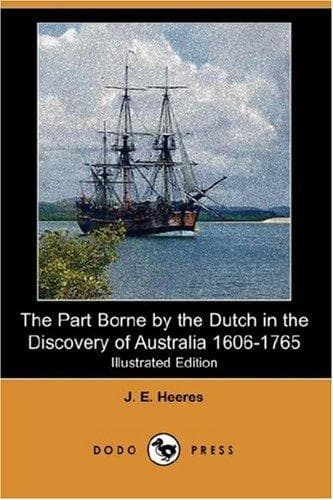
The Part Borne by the Dutch in the Discovery of Australia 1606-1765Heeres, J. E. (Jan Ernst)
History
The Part Borne by the Dutch in the Discovery of Australia 1606-1765
Heeres, J. E. (Jan Ernst)
Australia -- Discovery and exploration; Dutch -- Australia
That the island aforesaid is in 8° 8' Southern Latitude, about a mile
south and north of the mainland as before mentioned; it is pretty high,
having a great number of wild trees on the east-side, and being quite
bare on the west-side. It is about a quarter of a mile in circumference,
and is surrounded by numerous cliffs and rocks, overgrown with oysters
and mussels, the soil is excellent and fit to be planted and sown with
everything; by estimation it bears a hundred full-grown cocoanut-trees
and a great many younger ones; we also observed some banana- and
oubi-trees; we besides found fresh water here, which comes trickling
through the clay in small rills, and has to be gathered in pits dug for
the purpose; the island also contains large numbers of bats living in the
trees, on which account we have given to it the name of Vleermuys-Eylant
[Bats' Island] in the new chart. We have seen no huts or human beings in
it, but found unmistakable signs that there had been men here at some
previous time.
* * *
(Clappes Cust [Cocoanut Coast].)
On the 26th the weather was good, the wind N.N.W., course held S.E. by E.
along the land in 5 fathom. In the forenoon 4 small canoes put off from
the land and followed us; we waited for them to come alongside, and found
they were manned with 25 blacks, who had nothing with them except their
arms; they called out and made signs for us to come ashore; we then threw
out to them some small pieces of iron and strings of beads, at which they
showed great satisfaction; they paid little or no attention to the gold,
silver, copper, nutmegs and cloves which we showed them, though they were
quite ready to accept these articles as presents. Their canoes are very
skilfully made out of one piece of wood, some of them being so large that
they will hold 20 and even more blacks. Their paddles are long, and they
use them standing or sitting; the men are black, tall and well-built,
with coarse and strong limbs, and curly hair, like the Caffres, some of
them wearing it tied to the neck in a knot, and others letting it fall
loose down to the waist. They have hardly any beards; some of them have
two, others three holes through the nose, in which they wear fangs or
teeth of hogs or sword-fishes. They are stark-naked and have their
privities enclosed in a conch shell, fastened to the waist with a bit of
string; they wear no rings of gold, silver, copper, tin, or iron on their
persons, but adorn themselves with rings made of tortoise shell or
terturago (_Spanish_ tortuga?), from which it may be inferred that their
land yields no metals or wood of any value, but is all low-lying and
half-submerged, as we have actually found it to be; there were also among
them some not provided with paddles, but wearing two strings of human
teeth round their necks, and excelling all the others in ugliness; these
men carried on the left arm a hammer with a wooden handle and at one end
a black conch-shell, the size of a man's fist, the other end by which
Public-domain text, read in full here on John Shaqi.
Reviews
Reviews
No reviews yet
Be the first to share your thoughts on this work.
Elsewhere in the archive
Join the Discussion
Join the discussion
Sign in to leave a comment or review.
Sign InorCreate an account