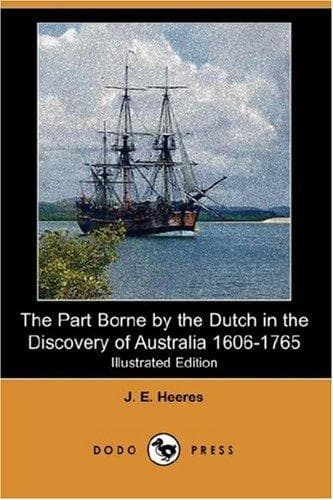
The Part Borne by the Dutch in the Discovery of Australia 1606-1765Heeres, J. E. (Jan Ernst)
History
The Part Borne by the Dutch in the Discovery of Australia 1606-1765
Heeres, J. E. (Jan Ernst)
Australia -- Discovery and exploration; Dutch -- Australia
After hearing the aforesaid reports touching the little depths sounded to
eastward, we are sufficiently assured that it will prove impossible any
longer to follow the coastline which we have so long skirted in an
eastward direction, and that we shall, to our great regret, be compelled
to return the same way we have come, seeing that we have been caught in
the shallows as in a trap; for this purpose we shall have to tack about
and take advantage of the ebb, and as soon as we get into deeper water,
to run south to the sixteenth degree or even farther, if it shall be found
advisable; then turn the ships' heads to the north along the coast of
Nova Guinea, according to our previous resolution taken on the 6th of
March last; as mentioned before, we were here in 9° 6' S. Lat., about 125
miles east of Aru, and according to the chart we had with us and the
estimation of the skippers and steersmen, no more than 2 miles from Nova
Guinea, so that the space between us and Nova Guinea seems to be a bight
to which on account of its shallows we have given the name of drooge
bocht [*] [shallow bight] in the new chart; to the land which we had run
along up to now, we have by resolution given the name of 't Westeinde van
Nova Guinea (Western extremity of N. G.), seeing that we have in reality
found the land to be an unbroken coast, which in the chart is marked as
islands, such as Ceram and the Papues, owing to misunderstanding and
untrustworthy information.
[* Entrance of Torres Strait.]
APRIL.
On the first the wind was W. by S. with good weather; we weighed anchor
and drifted with the ebb running from the N.E. when we had run 1Ω mile
with the tide to the S.W., we came to anchor again in 6 fathom.
On the second, the wind being W. by N., we tried to tack about to the W.
with the ebb-tide in 4, 5 and 6 fathom; we had variable winds the whole
day; towards the evening we cast anchor in 4 fathom three miles from the
land, having this day progressed 4 miles to the W. and W. by N.
On the third we set sail again at daybreak, the wind being N., course
kept W.N.W. in 7, 2, and 2Ω fathom, the water in these parts being of
greatly varying depths, so that we had to keep sounding continually; in
the afternoon we dropped anchor in 4 fathom, having drifted 2Ω, miles
with the ebb-tide.
On the 4th, the wind being N.E. by N., we set sail again with good
weather: in the afternoon we ran on with the tide and cast anchor in 7
fathom, having lost sight of the land, and sailed 8 miles W. and W. by N.
* * *
NOTE.
Here we managed with extreme difficulty and great peril to get again out
of the shallows aforesaid, into which we had sailed as into a trap,
between them and the land, for which happy deliverance God be praised;
the shallows extend South and North, from 4 to 9 miles from the mainland,
and are 10 miles in length from East to West.
{Page 35}
Public-domain text, read in full here on John Shaqi.
Reviews
Reviews
No reviews yet
Be the first to share your thoughts on this work.
Elsewhere in the archive
Join the Discussion
Join the discussion
Sign in to leave a comment or review.
Sign InorCreate an account