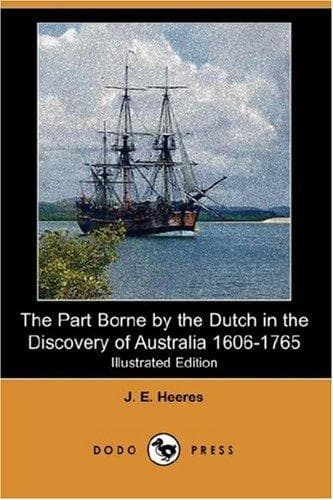
The Part Borne by the Dutch in the Discovery of Australia 1606-1765Heeres, J. E. (Jan Ernst)
History
The Part Borne by the Dutch in the Discovery of Australia 1606-1765
Heeres, J. E. (Jan Ernst)
Australia -- Discovery and exploration; Dutch -- Australia
On the 14th we made sail again before daybreak, with a S.E. wind and
steady weather; from the 9th of this month up to now we have found the
land of Nova Guinea to extend N.N.E. and S.S.W., and from this point
continuing N. and S. I went ashore here myself with the skipper and 10
musketeers and found a large number of footprints of men and dogs going
south; we also came upon a very fine fresh-water river, flowing into the
sea, whence fresh water can easily be obtained by means of boats or
pinnaces; the river is in 10° 50', and is marked Waterplaets in the
chart. The land here is high, hilly, and reefy near the sandy beach;
seeing that nothing profitable could be effected here, we returned to the
yacht, which was lying-by under small sail; towards the evening we were
at about 1 mile's distance from three islets, of which the southernmost
was the largest; five miles by estimation farther to northward we saw a
mountainous country, but the shallows rendered (or render) it impossible
for us to get near it; in almost every direction in which soundings were
taken, we found very shallow water, so that we sailed for a long time in
5, 4, 3, 2Ω, 2, 1Ω fathom and even less, so that at last we were forced
to drop anchor in 1Ω fathom, without knowing where to look for greater or
less depths; after sunset we therefore sent out the pinnace to take
soundings, which found deeper water a long way S.W. of the pinnace, viz.
2, 3, and 4Ω fathom; we were very glad to sail thither with the yacht,
and cast anchor in 8Ω fathom, fervently thanking God Almighty for his
inexpressible mercy and clemency, shown us in this emergency as in all
others.
In the morning of the 15th, the wind being S.E. with good weather, we set
sail on a W. course, which took us into shallower water of 2, 2Ω and 3
fathom; we therefore went over to S.W., when we came into 3Ω, 4, 5, 6
fathom and upwards; we had lost sight of the land here, and found it
impossible to touch at it or follow it any longer, owing to the shallows,
reefs and sandbanks and also to the E. winds blowing here; on which
account it was resolved and determined--in order to avoid such imminent
perils as might ultimately arise if we continued to coast along the land
any longer--to turn back and hold our course first for the Vleermuijs
Eijlant; we therefore stood out to sea on a W. course in 9Ω fathom and
upwards, having sailed 17 miles in 24 hours, kept west, and finding no
bottom in 27 fathom.
* * *
NOTE
That in our landings between 13° and 11° we have but two times seen black
men or savages, who received us much more hostilely than those more to
southward; they are also acquainted with muskets, of which they would
seem to have experienced the fatal effect when in 1606 the men of the
Duyffken made a landing here.
* * *
In the morning of the 16th, the wind was E.S.E. with good weather, the
Eastern monsoon having set in; course held N.N.W., at noon we were in 10°
27', having sailed 30 miles in 24 hours.
{Page 44}
Public-domain text, read in full here on John Shaqi.
Reviews
Reviews
No reviews yet
Be the first to share your thoughts on this work.
Elsewhere in the archive
Join the Discussion
Join the discussion
Sign in to leave a comment or review.
Sign InorCreate an account