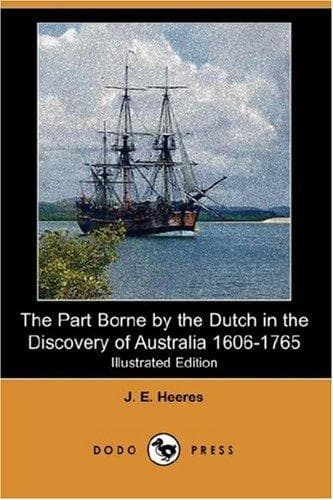
The Part Borne by the Dutch in the Discovery of Australia 1606-1765Heeres, J. E. (Jan Ernst)
History
The Part Borne by the Dutch in the Discovery of Australia 1606-1765
Heeres, J. E. (Jan Ernst)
Australia -- Discovery and exploration; Dutch -- Australia
_Letter Of Supercargo J. Van Roosenbergh to the Directors of the E.I.C.,
November 8, 1627._
Worshipful Wise Provident Very Discreet Gentlemen,
You have no doubt received my letter from Illa de Mayo...
On the 7th of September we resolved to run for the South-land, that we
might be near Java before the middle of October. On the 17th do. we
sighted the land of d'Eendracht near Dirck Hartochs reede [road-stead],
at about 7 miles' distance from us; the land was of middle height,
something like D'overen [Dover] in England; it is less low than has been
asserted by some, and of a whitish hue, so that at night it cannot be
seen before one is quite close to it. When by estimation we were at two
miles' distance from the land, the coast seemed to have a foreshore
consisting of small hills here and there. According to our observations
the land lay quite differently from what the chart would have us believe,
to wit, North by West and North-north-west, from a point three miles
south of the aforesaid height to a point 8 or 9 miles north of it; which
were the farthest points seen by us; this constituting a difference Of 3Ω
{Page 53} points with the chart, which makes it North-north-east and
South-south-west. We cast the lead five miles off the shore in 75 fathom,
muddy bottom mixed with small red pebbles, and five glasses afterwards,
two miles off shore, in 55 fathom sandy bottom, for hardly anything was
found sticking to the lead when heaved. We had seen no other signs of
land beyond gulf-weed floating about in small quantities just as in the
Sargasso Sea, and some land-birds flying high overhead. The many-coloured
birds which we met near the islands of Tristan de Aconcha, left us two
days before, just as they did when we got near Cabo de bone Esperança, so
that they would seem to dislike the land. Instead of them, we saw a black
bird with a white tail, having white streaks here and there under its
wings; a bird, it seems, of rare occurrence. Three or four days before we
also saw a number of sanderlings. Close inshore we also saw a quantity of
cuttlebone, but the pieces were very small and scattered, so that they
could hardly be seen in hollow water, except by paying very close
attention to them and only 6 or 8 miles off shore, seeing that the steady
west-wind prevents their getting out to sea, which they would certainly
do, if now and then the wind blew from the east for a few days in
succession. Careful estimations based on the globosity of the earth will
give the best signs after all. By estimation we have got into...[*]
Longitude, some of our steersmen having got one or two degrees more, some
less, which in the plane charts makes a considerable difference, about
217 miles by calculation. I repeat that since I have seen the land a good
deal earlier, it will be expedient in the plane chart to mark out a
distance of about 200 miles, to westward of St. Paulo island and to
eastward of Madagascar, the said distance to be passed over in drawing up
Public-domain text, read in full here on John Shaqi.
Reviews
Reviews
No reviews yet
Be the first to share your thoughts on this work.
Elsewhere in the archive
Join the Discussion
Join the discussion
Sign in to leave a comment or review.
Sign InorCreate an account