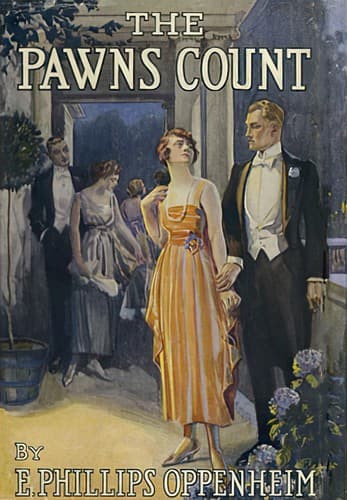
The Pawns CountOppenheim, E. Phillips (Edward Phillips)
General
The Pawns Count
Oppenheim, E. Phillips (Edward Phillips)
Detective and mystery stories
Fischer took his leave and reached his hotel a little before midnight.
Already he had begun to look over his shoulder in the street. He found
his rooms empty with a sense of relief, marred by one little
disappointment. Nikasti was to have been there to bid him farewell--
Nikasti on his way back to Japan. He ascertained from the office of the
hotel that there had been no telephone message or caller. Then he
turned to his correspondence, some presentiment already clutching at
his strained nerves. There was a letter in a large envelope, near the
bottom of the pile, addressed to him in Nikasti's fine handwriting. He
tore open the envelope, and slow horror seized him as he realised its
contents. A long photograph unrolled itself before his eyes. The first
few words brought confusion and horror to his sense. His brain reeled.
This was defeat, indeed! It was a photograph of that other autograph
letter. The one which he had given to Nikasti to carry to Japan lay--
gross sacrilege!--about him in small pieces. There was no other line,
no message, nothing but this damning proof of his duplicity.
A kind of mental torture seized him. He fought like a caged man for
some way out. Every sort of explanation occurred to him only to be
rejected, every sort of subterfuge, only to be cast aside with a kind
of ghastly contempt. He felt suddenly stripped bare. His tongue could
serve him no more. He snatched at the telephone receiver and rang up
the number for which he searched eagerly through the book.
"Is that the office of the American Steamship Company?" he asked.
"Yes."
"What time will the _New York_ sail?"
"In three-quarters of an hour. Who's speaking?"
"Mr. Oscar Fischer. Keep anything you have for me."
He threw down the receiver for fear of a refusal, packed a few things
feverishly in a dressing bag, dashed the rest of his correspondence
into his pocket, and with the bag in one hand, and an overcoat over the
other arm, he hastened out into the street. He was obliged at first to
board a street car. Afterwards he found a taxicab, and drove under the
great wooden shed as the last siren was blowing. He hurried up the
gangway, a grim, remorseful figure, a sense of defeat gnawing at his
heart, a bitter, haunting fear still with him even when, with a shriek
of the tugs, the great steamer swung into the river. He was leaving
forever the work to which he had given so much of his life, leaving it
a fugitive and dishonoured. The blaze of lights, the screaming of the
great ferry-boats, all the triumphant, brazen noises of the mighty
city, sounded like a requiem to him as in the darkest part of the
promenade deck he leaned over the railing and nursed his agony, the
supreme agony of an ambitious man--failure.
CHAPTER XXXVII
"What has become," Mrs. Theodore Hastings asked her niece one afternoon
about a month later, "of your delightful friend, Mr. Lutchester?"
Pamela laid down her book and looked across at her aunt with wide-open
eyes.
Public-domain text, read in full here on John Shaqi.
Reviews
Reviews
No reviews yet
Be the first to share your thoughts on this work.
Elsewhere in the archive
Join the Discussion
Join the discussion
Sign in to leave a comment or review.
Sign InorCreate an account