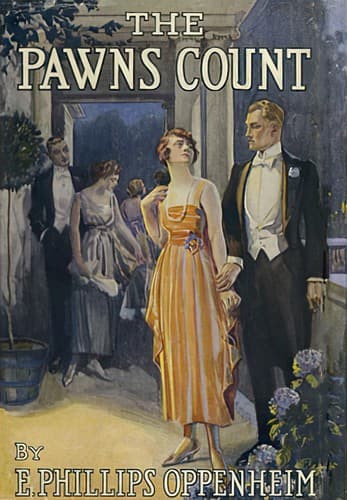
The Pawns CountOppenheim, E. Phillips (Edward Phillips)
General
The Pawns Count
Oppenheim, E. Phillips (Edward Phillips)
Detective and mystery stories
Lutchester's behaviour was admirable. His glance swept their little
table without even a shadow of interest. He ignored with passive
unconcern the mistake of Van Teyl's attempted greeting. He looked
through Fischer as though he had been a ghost. He stood by Sonia's side
while she seated herself, and listened with courteous pleasure to her
excited admiration of the flowers and the wonderful vista. Then he took
his own place. In his right hand he was carrying an evening paper with
its flaming headlines.
"That," Fischer pronounced, struggling to keep the joy from his tone,
"is very British and very magnificent!"
* * * * *
Pamela had imperfect recollections of the rest of the evening. She
remembered that she was more than usually gay throughout dinner-time,
but that she was the first to jump at the idea of a hurried departure
and a visit to a cabaret. Every now and then she caught a glimpse of
Sonia's face, saw the challenging light in her brilliant eyes, heard
little scraps of her conversation. The Frenchwoman spoke always in her
own language, with a rather shrill voice, which made Lutchester's
replies sound graver and quieter than usual. More than once Pamela's
eyes rested upon the broad lines of his back. He sat all the time like
a rock, courteous, at times obviously amusing, but underneath it all
she fancied that she saw some signs of the disturbance from which she
herself was suffering. She rose to her feet at last with a little sigh
of relief. It was an ordeal through which she had passed.
Once in the lift, her brother and Fischer discussed Lutchester's
indiscretion volubly.
"I suppose," Van Teyl declared, "that there isn't a man in New York who
wouldn't have jumped at the chance of dining alone with Sonia, but for
an Englishman, on a night like this," he went on, glancing at the
paper, "say, he must have some nerve!"
"Or else," Fischer remarked, "a wonderful indifference. So far as I
have studied the Anglo-Saxon temperament, I should be inclined to vote
for the indifference. That is why I think Germany will win the war.
Every man in that country prays for his country's success, not only in
words, but with his soul. I have not found the same spirit in England."
"The English people," Pamela interposed, "have a genius for concealment
which amounts to stupidity."
"I have a theory," Fischer said, "that to be phlegmatic after a certain
pitch is a sign of low vitality. However, we shall see. Certainly, if
England is to be saved from her present trouble, it will not be the
Lutchesters of the world who will do it, nor, it seems, her Navy."
Public-domain text, read in full here on John Shaqi.
Reviews
Reviews
No reviews yet
Be the first to share your thoughts on this work.
Elsewhere in the archive
Join the Discussion
Join the discussion
Sign in to leave a comment or review.
Sign InorCreate an account