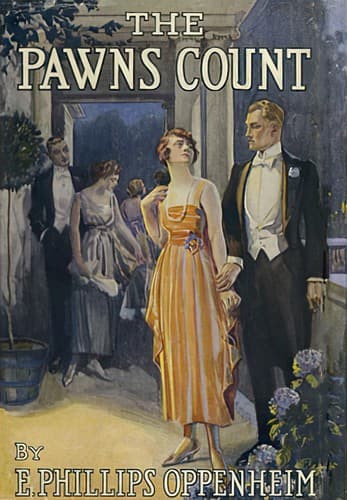
The Pawns CountOppenheim, E. Phillips (Edward Phillips)
General
The Pawns Count
Oppenheim, E. Phillips (Edward Phillips)
Detective and mystery stories
"I will not talk of these things with you," she cried. "It was not for
this that you sought me out, eh? Tell me at once? Were these the
thoughts you had in your mind when you sent your little note?--when you
chose to show yourself once more in my life?"
For the first time of his own accord, he drew his chair a little nearer
to hers. He took her hand. She gave him both unresistingly.
"Listen, dear Sonia," he said, "it is true that I am a changed man. I
am older than when we met last, and there are the other things. You
remember the Chateau d'Albert?"
"Of course!" she murmured. "And the young Duc d'Albert's wonderful
house party. We all motored there from Paris. You and I were together!
You have forgotten that, eh?"
"I lay in that orchard for two days," he went on grimly, "with a hole
in my side and one leg pretty nearly done for. I saw things I can never
forget, in those days, Sonia. D'Albert himself was killed. It was in
that first mad rush. Of the Chateau there remains but four blackened
walls."
"_Pauvre enfant_!" she murmured. "But you are well and strong again
now, is it not so? You will not fight again, eh? You were never a
soldier, dear friend."
"Just now," he confided, "I have other work to do. It is that other
work which has brought me to America."
She drew him a little closer to her. Her eyes questioned him.
"There is, perhaps, now," she asked, "a woman in your life?"
"There is," he admitted.
She made a grimace.
"But how clumsy to tell me, even though I asked," she exclaimed. "What
is she like? ... But no, I do not wish to hear of her! If she is all
the world to you, why did you send me that little note? Why are you
here?"
"Because we were once dear friends, Sonia," he said, "because I wish to
save you from great trouble."
She shrank from him a little fearfully.
"What do you mean?"
"Sonia," he continued, with a note of sternness in his tone, "during
the last two years you have gone back and forth between New York and
Paris, six times. I do not think that you can make that journey again."
She was standing now, with one hand gripping the edge of the table.
"John! ... John! ... What do you mean?" she demanded, and this time her
own voice was hard.
"I mean," he said, "that when you leave here for Paris you will be
watched day and night. The moment you set foot upon French soil you
will be arrested and searched. If anything is found upon you, such as a
message from your friend in Washington--well, you know what it would
mean. Can't you see, you foolish child, the risk you have been running?
Would you care to be branded as a spy?--you, a daughter of France?"
She struck at him. Her lace sleeves had fallen back, and her white arm,
with its little clenched fist, flashed through the twilight, aimlessly
yet passionately.
"You dare to call me a spy! You, John?" she shrieked. "But it is
horrible."
Public-domain text, read in full here on John Shaqi.
Reviews
Reviews
No reviews yet
Be the first to share your thoughts on this work.
Elsewhere in the archive
Join the Discussion
Join the discussion
Sign in to leave a comment or review.
Sign InorCreate an account