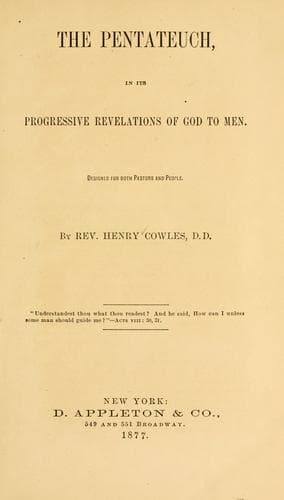
The Pentateuch, in Its Progressive Revelations of God to MenCowles, Henry
Religion
The Pentateuch, in Its Progressive Revelations of God to Men
Cowles, Henry
Bible. Pentateuch -- Criticism, interpretation, etc.
I. The reader of Gen. 34 and 35 and 37 and 38 will see that the ten
older brethren of Joseph were “hard boys.” The sacred historian must
have been quite willing to give this impression, else he would not
have recorded Reuben’s incest with his father’s concubine (35: 22),
nor Judah’s criminal connection with a supposed harlot who proved
to be his own daughter-in-law (Gen. 38), nor the pitiless cruelty of
Simeon and Levi when stirred up to revenge the dishonor done to their
sister Dinah (Gen. 34). Especially do the worst elements of depraved
character appear in their treatment of their younger brother Joseph.
The narrative (Gen. 37) is brief; gives facts without comments; but
_what facts_! Joseph was young and very simple-hearted. Up to the point
where the history introduces him, he had been trained in a religious
home――which seems scarcely to have been the case with the ten older
sons. Their shepherd life took them into distant parts of the country,
and seems practically to have removed them much of the time from home
and its domestic influences. Unfortunately the domestic influences
of that polygamous home were by no means so wholesome as a religious
home ought to furnish. Envy and jealousy were stimulated into fearful
strength.
Joseph was sent to help the sons of Bilhah and Zilpah. Painfully
impressed by their misdeeds, he reported them to his father. The
special love of this aged father for Joseph, manifested in the “coat
of many colors” (really a long tunic reaching to the wrists and ankles)
occasioned more rankling jealousy. Finally, Joseph’s remarkable dreams
which his simplicity related without apparently a thought of giving
offense, brought their animosity to its climax. Soon Joseph is thrown
into their power. They see him coming and conspire to take his life.
“Come,” (say they) “let us slay him and cast him into some pit, and we
will say, Some evil beast hath devoured him; and we shall see what will
become of his dreams.” We are not told which of them suggested this
murderous purpose. Reuben, the eldest brother, was the first to protest.
His plan was that they should cast him alive into some pit; and then in
their absence he could take him out and return him safely to his father.
They consented; stripped him of his new coat, and cast him into a pit
without water. [These pits were dug in that poorly watered country for
the sake of getting water for their cattle.] Then they sat down to eat
bread, perhaps complimenting themselves that they had not murdered him,
but had shown their power and for the present had put him out of their
way. Manifestly their consciences were dead to that sense of guilt
which a few years later forced them to say, “We are verily guilty
concerning our brother in that we saw the anguish of his soul when he
besought us and we would not hear” (Gen. 42: 21). Just then a caravan
of Ishmaelites and Midianites came in sight, moving toward Egypt, and
Judah came to the rescue with the proposition to take up Joseph and
Public-domain text, read in full here on John Shaqi.
Reviews
Reviews
No reviews yet
Be the first to share your thoughts on this work.
Elsewhere in the archive
Join the Discussion
Join the discussion
Sign in to leave a comment or review.
Sign InorCreate an account