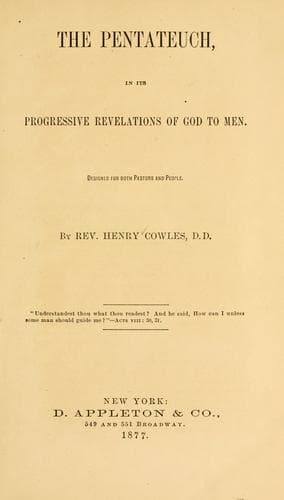
The Pentateuch, in Its Progressive Revelations of God to MenCowles, Henry
Religion
The Pentateuch, in Its Progressive Revelations of God to Men
Cowles, Henry
Bible. Pentateuch -- Criticism, interpretation, etc.
In conclusion I am constrained to say that the study of Egyptian
antiquities, though richly remunerative and satisfactory in regard to
almost every thing else, is still very dubious and perplexing in the
point of _definite chronology_. The views of the ablest scholars are
widely conflicting; the original authorities still wait for some master
mind to put them into system, or what is perhaps nearer the truth, for
the discovery of competent data from which a system can be constructed
which shall harmonize all the authorities in the case. We want to know
the Pharaoh to whom the Lord sent Moses, whose reign synchronizes with
the Exodus. We find a series of powerful monarchs in the eighteenth
dynasty and also in the nineteenth; but which of them answers to
this particular Pharaoh, it seems yet impossible to determine with
satisfactory certainty. Rameses II, all agree, was a powerful king;
built immense public works; reigned at least sixty, perhaps sixty-six
years;――but some authorities place him in the eighteenth and some in
the nineteenth dynasty, and the extreme difference in the assigned
dates for his reign is three hundred years.
The difficulties that invest Egyptian dates and dynasties seem at
present to be aggravated rather than relieved by the progress of modern
discoveries. Thus we find in the Bib. Sacra, Oct. 1867, (pp. 773 and
774) four parallel lists of the first three Egyptian dynasties, viz:
(1.) That of Manetho; (2.) The Turin Papyrus; (3.) The Tablet of Sethos;
(4.) The Tablet of Sakharah or Memphis. Compared with Manetho, the last
three are of quite recent discovery. They are somewhat defective; yet
it is not specially difficult to discover a striking similarity and
in many cases an obvious identity in the names given. But the names
in Manetho’s list almost utterly lack even similarity; much more do
they refuse to come into identity. The authority of the last three
must, it seems to me, be decidedly greater than that of Manetho.――――The
same difficulty appears when we compare Manetho’s names in the later
dynasties (_e. g._ 18th–20th) with names constantly coming to light
in recently discovered Egyptian monuments. I know not how this fact
affects other minds. It can not but lessen my confidence in the
lists of Manetho. It certainly goes far to lessen their practical
value.――――It is somewhat disheartening that these chronological
difficulties clear up so slowly. It still remains to be hoped that
light will yet break in and that conclusions will be reached in which
all important authorities will be shown to concur.[36]
Public-domain text, read in full here on John Shaqi.
Reviews
Reviews
No reviews yet
Be the first to share your thoughts on this work.
Elsewhere in the archive
Join the Discussion
Join the discussion
Sign in to leave a comment or review.
Sign InorCreate an account