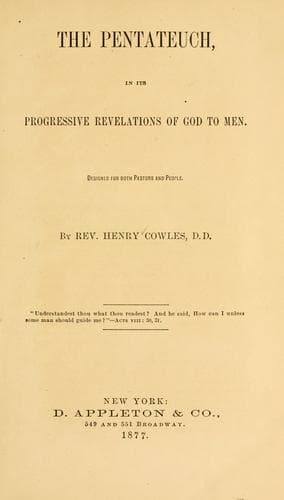
The Pentateuch, in Its Progressive Revelations of God to MenCowles, Henry
Religion
The Pentateuch, in Its Progressive Revelations of God to Men
Cowles, Henry
Bible. Pentateuch -- Criticism, interpretation, etc.
As to prior occupation, Michaelis says the original home of the
Canaanites was Arabia; that Herodotus testifies that at first they
dwelt near the Red Sea; Justin, that they had another country before
they came to Palestine; and Abulfeda that they dwelt in Arabia. But
in proof that they were in Palestine before Abraham was, Moses affirms
(Gen. 12: 6) that when Abram first passed through, “the Canaanite was
then in the land;” also that when Abram and Lot, being rich in cattle
and “the land unable to bear them,” “the Canaanite and the Perizzite
were then in the land” (Gen. 13: 7); and further still in his earliest
account of the location of primitive families after the flood, he
says――“The border of the Canaanites was from Sidon as thou comest
to Gerar unto Gaza as thou goest to Sodom and Gomorrah,” etc. (Gen.
10: 19). This is the oldest known historic testimony, and unquestionably
locates the Canaanites in the original land of Canaan.――――Moreover, it
is said that Abraham went with his flocks and herds wherever he would
as if lord of the country. It may be replied――So apparently did the
Canaanites also. If Abraham dug wells, so did they; if he buried his
dead there, so did they――with this incidental fact in their favor; viz.
that Abraham bought ground of them and paid money for his cemetery at
Macpelah. This special argument from prior possession can scarcely be
sustained.
But it may be maintained that Abram was there _very early_; and what is
more, God’s first call to him to leave his native country named Canaan
as his promised land; and every successive promise reaffirmed this
gift. Abraham’s title to Canaan therefore rests on God’s right to give
a perfect title. If the Lord of heaven and earth, the Great Creator of
all lands in all the ends of the earth had not a right to give Canaan
to Abraham and his posterity, then _he is not God_. Unquestionably
he assumed this right and in the exercise of it pledged Canaan to
the posterity of Abraham with perpetual reiteration and most solemn
covenant. This fact is the more significant because it is the first
step in a series of acts all of which aimed to reveal himself before
the world of mankind as the true God and the Lord of the whole earth.
With these ends in view he chose this people and made them his own;
manifested himself among them and before all the world as their
covenant-keeping God; gave them Canaan, and by manifold miracles helped
them to gain possession of it. Nor is this argument weakened by the
fact that by means of a special series of providences he led them down
into Egypt to dwell there 430 years; suffering the Canaanites meanwhile
to hold Canaan, not driving them out earlier because “the iniquity of
the Amorites was not yet full” (Gen. 15: 16). Here is suggested the
real ground on which the edict for extirpating the Canaanites was made
to rest. God suffered them to remain there until they had forfeited
their title not to Canaan alone, but to life itself and to any further
Public-domain text, read in full here on John Shaqi.
Reviews
Reviews
No reviews yet
Be the first to share your thoughts on this work.
Elsewhere in the archive
Join the Discussion
Join the discussion
Sign in to leave a comment or review.
Sign InorCreate an account