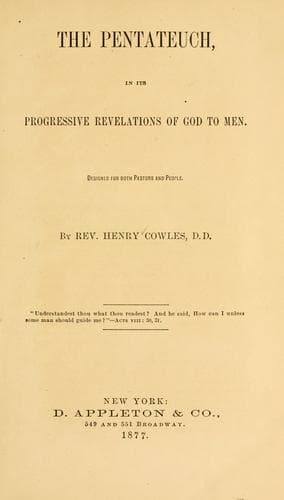
The Pentateuch, in Its Progressive Revelations of God to MenCowles, Henry
Religion
The Pentateuch, in Its Progressive Revelations of God to Men
Cowles, Henry
Bible. Pentateuch -- Criticism, interpretation, etc.
The objector will perhaps say――He might have sunk all Canaan under a
second flood like that of Noah’s time, and no complaint could stand
against him. He might have engulfed those cities in fire as he did
guilty Sodom, and all the living, cognizant of the moral grounds of
the act, would have said, Amen! But that he should set such an example
of _war_――the most horrid of all wars――before the nations of all
history――before the ages of all time, giving it his holy sanction――nay
more, setting his own most holy people to the bloody work――this is
unpardonable. That he should put them to such barbarities――subject them
to such demoralization of all the finer sensibilities of the human soul,
seems too horrid to be thought of!
It is perhaps well to meet this question in its strongest form, with
its objectionable points in their most revolting aspect.
I do not feel called upon to say one word to soften down any man’s
sense of the horrors of war. War _is_ horrid――but sin is more
horrid――certainly such sin as that of the old Canaanites. In fact war
is horrid――not mainly because of the suffering but because of the
_sin_ that may be in it. And this suggests the true and just reply to
be made to the objection now before us, viz. that such a war as that
of Israel against the Canaanites, waged in obedience to God; waged
for the destruction of such sinners and to cleanse the earth from such
unutterable abominations and pollutions, is _not_ demoralizing――is
not so either necessarily or even naturally; but if done in honest
obedience to God and with a due sense of the grounds on which God
commanded it, must have been the very opposite of demoralizing;
must have educated the nation of Israel to a juster sense of the
abominations of idolatry and of the righteous moral government of God
over the wicked in the present world. It can not be doubted that these
were the ends which God sought to secure in putting this service upon
Israel. A lower object to be reached was to vacate the land of Canaan
for Israel to occupy; but the far higher object was to wash the land
of its moral pollutions; to break down and blot out nations too corrupt
to live. The Lord devolved this extirpation upon Israel that they
might thereby get a deeper sense of his abhorrence of such sin――not
to say also, a juster view of the intrinsic abominations which God
commissioned them to punish.
Or we may put the argument thus: Given――the great historic fact,
the moral corruption of the nations of Canaan and the moral purpose
of God to exterminate those nations for their corruption. The
choice of methods lies between _miracles_ on the one hand, and the
war-force of Israel, backed up by God’s providential agencies, on the
other:――miracles as in the flood and on Sodom: or the war-commission
given to his people Israel.
Now consider.――――1. Miracles had already been employed repeatedly
before the eyes of mankind, and the Lord might for this reason wisely
vary his methods, for the greater and better effect.
Public-domain text, read in full here on John Shaqi.
Reviews
Reviews
No reviews yet
Be the first to share your thoughts on this work.
Elsewhere in the archive
Join the Discussion
Join the discussion
Sign in to leave a comment or review.
Sign InorCreate an account