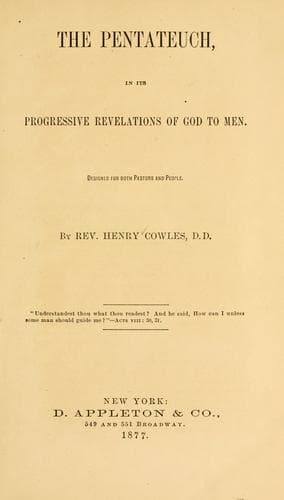
The Pentateuch, in Its Progressive Revelations of God to MenCowles, Henry
Religion
The Pentateuch, in Its Progressive Revelations of God to Men
Cowles, Henry
Bible. Pentateuch -- Criticism, interpretation, etc.
6. _Magic Arts._ In examining the statutes on this point, we are
struck with the number and variety of names which designate these arts.
The standard enumeration (Deut. 18: 10, 11) gives at least _eight_;
viz.――――(1.) “He that useth divination”――professing to gain knowledge
and power more than human and in some sense divine:――――(2.) “An
observer of times”――the Hebrew word being related to _cloud_, perhaps
in the sense of covering, hiding, as the cloud shuts off the sun’s
light; practicing covert arts:――――(3.) “An enchanter”――the original
suggesting the serpent, and implying either a hissing, in imitation of
the serpent; or the practice of charming serpents, yet always connected
with the arts of divination:――――(4.) “A witch”――the Hebrew word
signifying one who mutters incantations, its cognate words having the
sense of praying, but in Hebrew only in the bad sense of seeking help
from others than God:――――(5.) “The charmer”――a word which suggests
_binding_ as with the spell of enchantment――“spell-bound”; often
used of the charming of serpents:――――(6.) “A consulter with familiar
spirits”; (Heb.) one who prays to the bottle-man――the Hebrew word
for bottle being applied to the ventriloquist from whose body came
forth unearthly sounds as from a second being imprisoned within him.
Ventriloquism was one of the arts practiced by the ancient magicians
to excite the wonder and to command the belief of the credulous.――――The
English phrase――“familiar spirit”――signifies spirits who stand in such
a relation to the performer that they _come at his call_, like servants
of his _family_, he having the power to evoke them at his will. Of
course it is pretended that these spirits are other than human and
greater than human spirits can be while yet in the body. The original
Hebrew [Ob] comes down to us in the African “Obe-man” who still follows
the same profession, by means of similar arts.――――(7.) “The wizard”
is one who claims superhuman wisdom――the old English accurately
translating the Hebrew: the distinctively _wise one_. Of course the
word is restricted in usage to this sort of superior wisdom――that which
is gained by the arts of magic.――――(8.) “The necromancer”――precisely
the spiritist of modern times――or rather, of all time――who claims to
have communion with the spirits of dead men.[41]
Public-domain text, read in full here on John Shaqi.
Reviews
Reviews
No reviews yet
Be the first to share your thoughts on this work.
Elsewhere in the archive
Join the Discussion
Join the discussion
Sign in to leave a comment or review.
Sign InorCreate an account