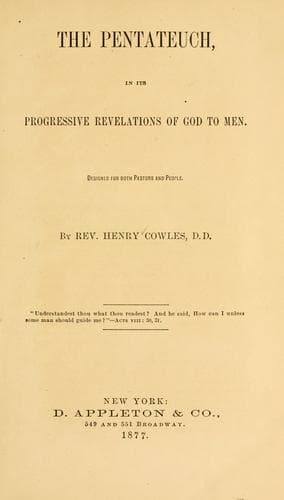
The Pentateuch, in Its Progressive Revelations of God to MenCowles, Henry
Religion
The Pentateuch, in Its Progressive Revelations of God to Men
Cowles, Henry
Bible. Pentateuch -- Criticism, interpretation, etc.
Scarcely of the nature of sacrifice, yet intensifying the idea of
ceremonial uncleanness was the burning of the “red heifer”――the
gathering up of her ashes and the preparation from them of “the water
of separation”――a purification from sin in the ceremonial sense. Num.
19 gives the details, specifying the sorts of uncleanness which this
purifying water washed away. The writer to the Hebrews (9: 13, 14)
gave the great moral inference thus: “For if the blood of bulls and
of goats and the ashes of an heifer sprinkling the unclean sanctifieth
to the purifying of the flesh, how much more shall the blood of Christ
who through the eternal Spirit offered himself unto God, purge your
conscience from dead works to serve the living God”?
II. STATED TIMES AND SEASONS OF WORSHIP.
1. _The Morning and Evening Sacrifice._
Two lambs of one year were offered every day; the one in the morning
and the other at evening [Heb. “between the evenings”]; burnt offerings,
consumed wholly upon the altar. They were accompanied with a small
portion of flour, oil, and wine. This was a perpetual ordinance,
never to be omitted. The original institution (Ex. 29: 38–46) is
accompanied with God’s very gracious promise to meet with his people
and dwell among them, sanctifying the place of this meeting by his
glory. Nothing could suggest more pertinently and tenderly that God
loves to see the face of his worshiping people and to meet them as each
day opens in the morning and as it closes with the setting sun. Let
this communion between God and his sons and daughters never be in any
wise interrupted.――――The usage seems to have led pious Jews in later
times to adopt these hours for their morning and evening prayer, as
we may see in the case of Daniel (9: 21), and in the New Testament
history.――――The ritual for these sacrifices is given in detail
(Num. 28: 3–8).
2. _The Sacrifices for the Sabbath._
Each Sabbath had an extra service in addition to the continual morning
and evening sacrifice――two lambs of the first year without spot; with
the attendant meat and drink-offerings (Num. 29: 9, 10).
* * * * *
3. _The sacrifices at each new moon_ were on a larger scale than
either of the preceding, viz. two young bullocks, one ram, and seven
lambs for the burnt-offering; one kid of goats for the sin-offering.
As the Hebrew months were lunar (not solar), these sacrifices upon
the appearance of the new moon inaugurated the successive months. It
was probably for this reason that they were announced with blowing
of trumpets (Num. 10: 10). The calendar was thus regulated――a matter
of special importance, since it fixed the time of their three great
religious festivals as also the great day of atonement.
4. _The Three Great Religious Festivals._
Of these the first in order (the Passover) has been considered already.
Public-domain text, read in full here on John Shaqi.
Reviews
Reviews
No reviews yet
Be the first to share your thoughts on this work.
Elsewhere in the archive
Join the Discussion
Join the discussion
Sign in to leave a comment or review.
Sign InorCreate an account