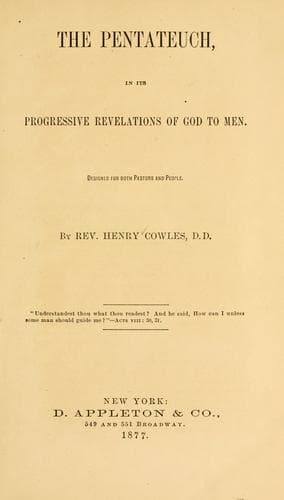
The Pentateuch, in Its Progressive Revelations of God to MenCowles, Henry
Religion
The Pentateuch, in Its Progressive Revelations of God to Men
Cowles, Henry
Bible. Pentateuch -- Criticism, interpretation, etc.
This argument will be appreciated by those who duly consider, on the
one hand, that if man were on the earth in those pre-Adamic ages, it is
in the highest degree improbable that his population ranged at a dozen
for the area of all France, and a few hundreds only to a continent――for
what should forbid him as well as the lower animals to “be fruitful and
multiply and replenish the earth”? Besides, a population so sparse and
consequently weak could have made no stand against armies of hyenas,
leopards, bears and lions.――――On the other hand, the occurrence of
human bones, in numbers so very few and so remote from each other,
will be much more rationally accounted for by the possibilities above
indicated.
Yet let it be understood:――The way is open for any extent of further
investigation. We have no occasion to fear the result of the search.
Let the rocks be torn up and examined; let mountains be tunneled and
canals be dug; let railroad grading go where it will; if the human
skeleton should be found where none of these or similar possibilities
admit its date since Adam, we will certainly give the case all due
consideration and weight.
(B.) Next is the argument _from man’s work and from his tools_.
Here a larger field opens. My limits scarcely allow me to do more
than indicate briefly the present state of the question.――――Thus far
explorations have been mostly restricted to Northern and Western Europe,
say north of the Alps and of ancient Greece, in the regions anciently
known as Gaul, Germany, Scandinavia and Britain. The supposed remains
of man’s tools and work are found chiefly in caves and lake-dwellings,
or under drift, and only to a small extent in monuments above the
present surface. The lake-dwellings specially referred to are in
Switzerland, where during the very dry winter of 1853–4 several
remarkable villages were found built on piles below, the present
average watermark, which were once without doubt the abodes of men,
with quite abundant traces indicating their modes of life, civilization,
implements, and the contemporary animal races.[13]
The various stages of civilization developed in these ancient remains
have been usually classified under three heads:
1. The _Stone age_, in which man’s cutting implements, working tools
and weapons of war, were of stone. This age is sometimes subdivided,
the older part being called “Palaeolithic” [old stone], and the more
recent, “Neolithic” [new stone].
2. The _Bronze age_, its implements being chiefly of copper or brass.
3. The _Iron age_, where iron first appears.
Now the great question――the only one that comes within our range of
inquiry――is the _date_ of these traces of ancient men. When did the men
of the Stone age and of the Bronze and the Iron age live?
Public-domain text, read in full here on John Shaqi.
Reviews
Reviews
No reviews yet
Be the first to share your thoughts on this work.
Join the Discussion
Join the discussion
Sign in to leave a comment or review.
Sign InorCreate an account