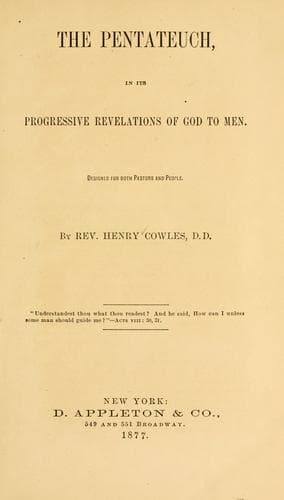
The Pentateuch, in Its Progressive Revelations of God to MenCowles, Henry
Religion
The Pentateuch, in Its Progressive Revelations of God to Men
Cowles, Henry
Bible. Pentateuch -- Criticism, interpretation, etc.
Reverting now to the obviously conflicting proof texts above cited,
we may note that Ex. 12: 40 is read variously――the Septuagint (Vatican
text) adding after “dwelt in Egypt,” the words――“and in the land of
Canaan;” while the Alexandrian text of the Septuagint adds also――“they
and their fathers.” Both these additions appear also in the Samaritan
text and in the Targum Jonathan; while the Masoretic Hebrew is
supported by the more reliable Targum of Onkelos; also by the Syriac
and the Vulgate. These additions as in the Septuagint are clumsily
made. The dwelling in Canaan, referring to Abraham and Isaac, should
come in _before_ the dwelling in Egypt if at all, and not _after_. The
diversity between the two texts of the Septuagint is suspicious. The
authority of the old Hebrew text stands unshaken.
The passage Gen. 15: 13 is strong to the same purport, since it was
“in a land _not his own_” (_i. e._ not Canaan), and was a state of
tyrannous oppression which was to continue 400 years――points which
forbid us to include in this 400 years the life-history of Abraham,
Isaac and Jacob.――――As to Paul (Gal. 3: 17) his readers had before them
only the Septuagint; he would therefore naturally follow its authority,
and the more readily because the difference between that and the Hebrew
in the length of the interval was a point of no importance to his
argument.
* * * * *
The evidence from the lapse of generations during the sojourn in Egypt
is of great, not to say decisive, importance to our question. Here,
however, opinions as to its bearing differ totally. One of the test
passages is Ex. 6: 16–20, which makes the whole age of Levi 137 years;
of Kohath, his son, 133; of Amram――apparently his son and the father
of Moses, 137. The age of Moses when he stood before Pharaoh (Ex. 7: 7)
was 80. Kohath was born in Canaan; his father was older by several
years than Benjamin; presumably, therefore, his children were older;
yet Benjamin had ten sons when he went down into Egypt (Gen. 46: 21).
If we suppose that Kohath was 25 when he went into Egypt, then he lived
there 108 years. Amram lived there 137, and Moses at the Exodus had
lived 80. With these given generations and ages, this computation is
stretched to its utmost extent since it supposes Kohath’s death at 133
and Amram’s birth to have occurred in the same year; also Amram’s death
at 137 and the birth of Moses to be in the same year; yet the sum is
only 325, which is less by 105 years than the long period. With these
data the short period (215) might be readily provided for.
Public-domain text, read in full here on John Shaqi.
Reviews
Reviews
No reviews yet
Be the first to share your thoughts on this work.
Elsewhere in the archive
Join the Discussion
Join the discussion
Sign in to leave a comment or review.
Sign InorCreate an account