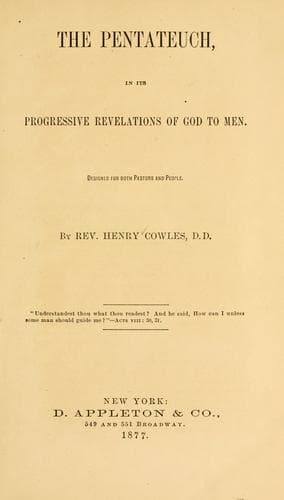
The Pentateuch, in Its Progressive Revelations of God to MenCowles, Henry
Religion
The Pentateuch, in Its Progressive Revelations of God to Men
Cowles, Henry
Bible. Pentateuch -- Criticism, interpretation, etc.
But several circumstances combine to show that there must be several
omitted links between the Amram here spoken of, and Kohath. For in this
genealogical list (Ex. 6: 16–20) we have but two names between Levi,
the tribe-father, and Moses, viz. Kohath and Amram. But between Joseph,
a younger tribe-father, and Zelophehad, a contemporary of Moses, there
are four intervening names (Num. 26: 28–33); between Judah and Bezaleel
there are six (1 Chron. 2: 3–5, 18–20); between Joseph (through Ephraim)
and Joshua, there are nine (1 Chron. 7: 22–27).――――Again, we have in
Num. 3: 27, 28, a census of the four Kohath families. The males, from
one month and upward, are 8600. If we set off one-fourth of these to
Amram (_i. e._ 2150) and remember that the Amram who was father to
Moses had but one other son, Aaron, (known to this genealogy) with four
sons, and that Moses had but two, we shall see it utterly impossible
that the male offspring of Moses and of Aaron could number 2150.
Therefore Amram, the immediate son of Kohath, must have been several
generations back of the Amram who was father of Moses.――――The genealogy
of Jochebed, the mother of Moses, might also be explained, but space
forbids.――――The vast increase of Hebrew population, from the 70 souls
who went down into Egypt to the 600,000 men of age for war who went out
(Ex. 12: 37), suggests a longer time than 215 years. The evidence on
the whole preponderates decisively against the shorter and in favor of
the longer period, 430 years.
* * * * *
Public-domain text, read in full here on John Shaqi.
Reviews
Reviews
No reviews yet
Be the first to share your thoughts on this work.
Elsewhere in the archive