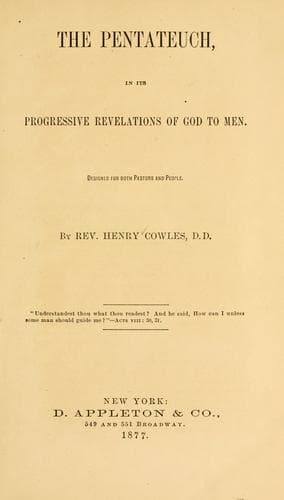
The Pentateuch, in Its Progressive Revelations of God to MenCowles, Henry
Religion
The Pentateuch, in Its Progressive Revelations of God to Men
Cowles, Henry
Bible. Pentateuch -- Criticism, interpretation, etc.
Yet let the minor points of this scene sink into the shade in the
presence of the sublime glory of the great first promise. In the light
of this we see that though Satan plotted the ruin of the race, yet
God counter-plotted the ruin of Satan and the salvation of the masses
of mankind. When it might have seemed that all was lost, it proved
that this extremity was God’s great opportunity, for his strong arm
was made bare for help and real victory. This is the birth-hour of
most momentous issues. Sin came in upon Eden and upon earth; and many
a bitter sorrow, many a cup of suffering and woe, must needs follow
in its train; but _Redemption comes in also_; it enters upon its
co-ordinate work to save the soul from sin and from eternal death and
to bring in everlasting righteousness. The history of our world in its
most vital aspects is foreshadowed here in this first short meeting of
their Maker with this sinning pair. The spoken recorded words were few,
but their significance was momentous; the sweep of their bearing, the
issues of the divine policy here indicated, were destined to fill up
the ages of time with stirring and strange conflict, and to send their
influence down through the endless ages of man’s being and of God’s
kingdom.
CHAPTER VII.
FROM THE FALL TO THE FLOOD.
1. _Notes on special passages._
In Gen. 4: 1 our English version stands――“I have gotten a man _from_
the Lord.” Some critics construe these words of Eve to mean――By the
help or blessing of the Lord; but the more direct and obvious sense
of the original is this: “I have gotten a man, the Lord”――as if she
assumed that this, her first-born son, was really the promised divine
“seed of the woman” who was to bruise the serpent’s head. The current
objection to this construction is that it is too far in advance of
Eve’s theology:――to which however the obvious reply is――Who knows how
far advanced Eve’s theology may have been? Her imagination may have
outrun the actual revelation at that point made. All we can say is that
these words are recorded as indicating her thought, and that this is
the most natural sense of her words.
In the Lord’s expostulation with Cain (4: 6, 7) we read: “If thou doest
well, shalt thou not be accepted?” but better――Would there not be an
elevation――_i. e._ of countenance, a cheerful _looking up_, instead
of that fallen, sullen look spoken of in the previous verse.――――“And
if thou doest not well, sin lies crouching at the door”――sin being
personified and thought of as some animal, perhaps the serpent, ready
to allure him on to deeper, more damning crime: “And _its_ (not _his_)
desire is toward thee”――its Satanic purpose is to ensnare and ruin
thee: “but thou shouldst rule over it”――in the sense of mastering its
temptations, commanding them down and ruling them out from thine heart.
Public-domain text, read in full here on John Shaqi.
Reviews
Reviews
No reviews yet
Be the first to share your thoughts on this work.
Elsewhere in the archive
Join the Discussion
Join the discussion
Sign in to leave a comment or review.
Sign InorCreate an account