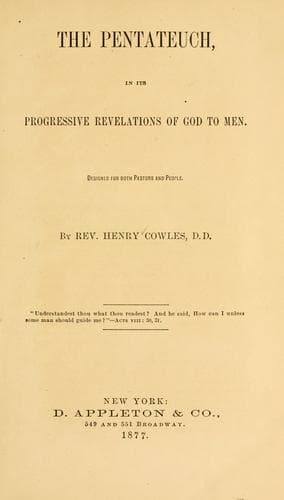
The Pentateuch, in Its Progressive Revelations of God to MenCowles, Henry
Religion
The Pentateuch, in Its Progressive Revelations of God to Men
Cowles, Henry
Bible. Pentateuch -- Criticism, interpretation, etc.
(4.) Yet another point in this cluster of great moral lessons
is indicated for us by Peter (2 Pet. 2: 4–9); “For if God spared
not the old world, but saved Noah, the eighth person, a preacher
of righteousness, bringing in the flood upon the world of the
ungodly:――the Lord knoweth how to deliver the godly out of temptation
and to preserve the unjust unto the day of judgment to be punished.”
That awful word, _retribution_, gathers into itself the fearful
significance of these stupendous events. They are God’s foregoing
judgments, brought out in this world to foreshadow the sorer
visitations of that coming day when God shall bring every work into
judgment with every secret thing, good or evil. God surely does take
note of the sins of men, how long soever he may stay his uplifted hand
and delay to smite. If wicked men were wise _they would believe God’s
words of warning_, and take care not to live over again the life of
that doomed generation and meet a final judgment more awful even than
theirs!
(5.) Let us not fail to notice those wonderful and beautiful ways
of God with his children, coming down in such condescending and most
familiar communion, talking with them apparently almost as man talks
with his dearest friend; and this not in Paradise only before the fall,
but after the fall scarcely less; and onward as the narrative indicates
in the case of Enoch and of Noah. What more could he have done to
reveal a _personal God_ to mortals? Surely the God who thus revealed
himself in the fresh morning of our race is no dim abstraction, no
impersonal Nature or Essence, diffused and diffusible throughout space,
the ideal soul of all matter. This effort to dispose of a God with whom
it is man’s privilege to walk in positive personal communion, but who
also takes cognizance of man’s iniquity, and to transmute him into an
empty, forceless ideality, finds not the least countenance in these
earliest manifestations of himself to our race. Note how he dwells with
men; how he walks with them and lets them walk with him! What is this
but free and loving communion? What less can it imply than just what
the narrative of man’s creation witnesseth, viz. that God “made man _in
his own image_”――capable therefore of real and most intimate communion
of spirit with his Maker? This lesson is written all the way through
the Bible. It stands out here with beautiful prominence in this first
great chapter of God’s revelation of himself to man.
CHAPTER VIII.
THE FLOOD.
Public-domain text, read in full here on John Shaqi.
Reviews
Reviews
No reviews yet
Be the first to share your thoughts on this work.
Elsewhere in the archive
Join the Discussion
Join the discussion
Sign in to leave a comment or review.
Sign InorCreate an account