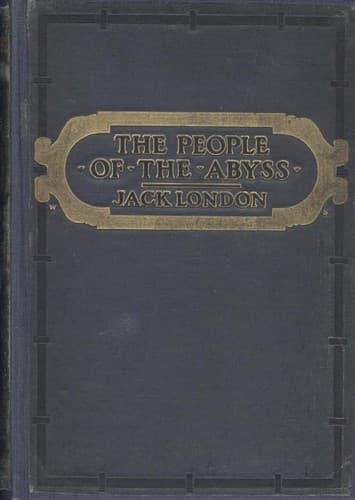
London (England) -- Social conditions; Poor -- England -- London
To the young working-man or working-woman, or married couple, there is
no assurance of happy or healthy middle life, nor of solvent old age.
Work as they will, they cannot make their future secure. It is all a
matter of chance. Everything depends upon the thing happening, the
thing with which they have nothing to do. Precaution cannot fend it
off, nor can wiles evade it. If they remain on the industrial
battlefield they must face it and take their chance against heavy odds.
Of course, if they are favourably made and are not tied by kinship
duties, they may run away from the industrial battlefield. In which
event the safest thing the man can do is to join the army; and for the
woman, possibly, to become a Red Cross nurse or go into a nunnery. In
either case they must forego home and children and all that makes life
worth living and old age other than a nightmare.
CHAPTER XXII.
SUICIDE
With life so precarious, and opportunity for the happiness of life so
remote, it is inevitable that life shall be cheap and suicide common.
So common is it, that one cannot pick up a daily paper without running
across it; while an attempt-at-suicide case in a police court excites
no more interest than an ordinary “drunk,” and is handled with the same
rapidity and unconcern.
I remember such a case in the Thames Police Court. I pride myself that
I have good eyes and ears, and a fair working knowledge of men and
things; but I confess, as I stood in that court-room, that I was half
bewildered by the amazing despatch with which drunks, disorderlies,
vagrants, brawlers, wife-beaters, thieves, fences, gamblers, and women
of the street went through the machine of justice. The dock stood in
the centre of the court (where the light is best), and into it and out
again stepped men, women, and children, in a stream as steady as the
stream of sentences which fell from the magistrate’s lips.
I was still pondering over a consumptive “fence” who had pleaded
inability to work and necessity for supporting wife and children, and
who had received a year at hard labour, when a young boy of about
twenty appeared in the dock. “Alfred Freeman,” I caught his name, but
failed to catch the charge. A stout and motherly-looking woman bobbed
up in the witness-box and began her testimony. Wife of the Britannia
lock-keeper, I learned she was. Time, night; a splash; she ran to the
lock and found the prisoner in the water.
I flashed my gaze from her to him. So that was the charge, self-murder.
He stood there dazed and unheeding, his bonny brown hair rumpled down
his forehead, his face haggard and careworn and boyish still.
“Yes, sir,” the lock-keeper’s wife was saying. “As fast as I pulled to
get ’im out, ’e crawled back. Then I called for ’elp, and some workmen
’appened along, and we got ’im out and turned ’im over to the
constable.”
Public-domain text, read in full here on John Shaqi.
Reviews
Reviews
No reviews yet
Be the first to share your thoughts on this work.
Elsewhere in the archive
Join the Discussion
Join the discussion
Sign in to leave a comment or review.
Sign InorCreate an account