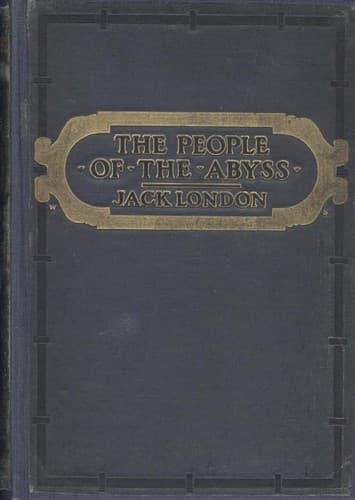
London (England) -- Social conditions; Poor -- England -- London
And there were others, strange, weird faces and forms and twisted
monstrosities that shouldered me on every side, inconceivable types of
sodden ugliness, the wrecks of society, the perambulating carcasses,
the living deaths—women, blasted by disease and drink till their shame
brought not tuppence in the open mart; and men, in fantastic rags,
wrenched by hardship and exposure out of all semblance of men, their
faces in a perpetual writhe of pain, grinning idiotically, shambling
like apes, dying with every step they took and each breath they drew.
And there were young girls, of eighteen and twenty, with trim bodies
and faces yet untouched with twist and bloat, who had fetched the
bottom of the Abyss plump, in one swift fall. And I remember a lad of
fourteen, and one of six or seven, white-faced and sickly, homeless,
the pair of them, who sat upon the pavement with their backs against a
railing and watched it all.
The unfit and the unneeded! Industry does not clamour for them. There
are no jobs going begging through lack of men and women. The dockers
crowd at the entrance gate, and curse and turn away when the foreman
does not give them a call. The engineers who have work pay six
shillings a week to their brother engineers who can find nothing to do;
514,000 textile workers oppose a resolution condemning the employment
of children under fifteen. Women, and plenty to spare, are found to
toil under the sweat-shop masters for tenpence a day of fourteen hours.
Alfred Freeman crawls to muddy death because he loses his job. Ellen
Hughes Hunt prefers Regent’s Canal to Islington Workhouse. Frank
Cavilla cuts the throats of his wife and children because he cannot
find work enough to give them food and shelter.
The unfit and the unneeded! The miserable and despised and forgotten,
dying in the social shambles. The progeny of prostitution—of the
prostitution of men and women and children, of flesh and blood, and
sparkle and spirit; in brief, the prostitution of labour. If this is
the best that civilisation can do for the human, then give us howling
and naked savagery. Far better to be a people of the wilderness and
desert, of the cave and the squatting-place, than to be a people of the
machine and the Abyss.
CHAPTER XXV.
THE HUNGER WAIL
“My father has more stamina than I, for he is country-born.”
The speaker, a bright young East Ender, was lamenting his poor physical
development.
“Look at my scrawny arm, will you.” He pulled up his sleeve. “Not
enough to eat, that’s what’s the matter with it. Oh, not now. I have
what I want to eat these days. But it’s too late. It can’t make up for
what I didn’t have to eat when I was a kiddy. Dad came up to London
from the Fen Country. Mother died, and there were six of us kiddies and
dad living in two small rooms.
Public-domain text, read in full here on John Shaqi.
Reviews
Reviews
No reviews yet
Be the first to share your thoughts on this work.
Elsewhere in the archive
Join the Discussion
Join the discussion
Sign in to leave a comment or review.
Sign InorCreate an account