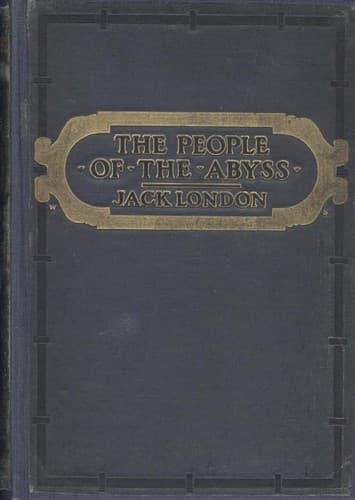
London (England) -- Social conditions; Poor -- England -- London
It was not a room. Courtesy to the language will no more permit it to
be called a room than it will permit a hovel to be called a mansion. It
was a den, a lair. Seven feet by eight were its dimensions, and the
ceiling was so low as not to give the cubic air space required by a
British soldier in barracks. A crazy couch, with ragged coverlets,
occupied nearly half the room. A rickety table, a chair, and a couple
of boxes left little space in which to turn around. Five dollars would
have purchased everything in sight. The floor was bare, while the walls
and ceiling were literally covered with blood marks and splotches. Each
mark represented a violent death—of an insect, for the place swarmed
with vermin, a plague with which no person could cope single-handed.
The man who had occupied this hole, one Dan Cullen, docker, was dying
in hospital. Yet he had impressed his personality on his miserable
surroundings sufficiently to give an inkling as to what sort of man he
was. On the walls were cheap pictures of Garibaldi, Engels, Dan Burns,
and other labour leaders, while on the table lay one of Walter Besant’s
novels. He knew his Shakespeare, I was told, and had read history,
sociology, and economics. And he was self-educated.
On the table, amidst a wonderful disarray, lay a sheet of paper on
which was scrawled: _Mr. Cullen, please return the large white jug and
corkscrew I lent you_—articles loaned, during the first stages of his
sickness, by a woman neighbour, and demanded back in anticipation of
his death. A large white jug and a corkscrew are far too valuable to a
creature of the Abyss to permit another creature to die in peace. To
the last, Dan Cullen’s soul must be harrowed by the sordidness out of
which it strove vainly to rise.
It is a brief little story, the story of Dan Cullen, but there is much
to read between the lines. He was born lowly, in a city and land where
the lines of caste are tightly drawn. All his days he toiled hard with
his body; and because he had opened the books, and been caught up by
the fires of the spirit, and could “write a letter like a lawyer,” he
had been selected by his fellows to toil hard for them with his brain.
He became a leader of the fruit-porters, represented the dockers on the
London Trades Council, and wrote trenchant articles for the labour
journals.
He did not cringe to other men, even though they were his economic
masters, and controlled the means whereby he lived, and he spoke his
mind freely, and fought the good fight. In the “Great Dock Strike” he
was guilty of taking a leading part. And that was the end of Dan
Cullen. From that day he was a marked man, and every day, for ten years
and more, he was “paid off” for what he had done.
Public-domain text, read in full here on John Shaqi.
Reviews
Reviews
No reviews yet
Be the first to share your thoughts on this work.
Elsewhere in the archive
Join the Discussion
Join the discussion
Sign in to leave a comment or review.
Sign InorCreate an account