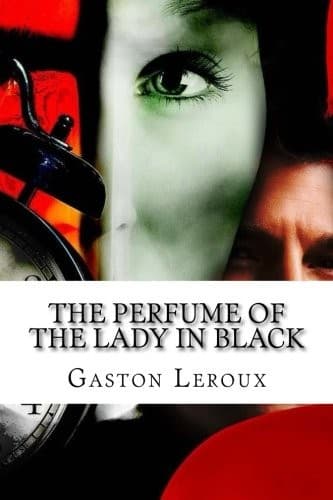
Detective and mystery stories; Rouletabille, Joseph (Fictitious character) -- Fiction
After the trial at Versailles, Arthur Rance had returned to
Philadelphia, and there, one evening, at a family dinner party, he had
found himself seated beside a charming young girl, who had interested
him at once by a display of interest in literature and art, the
like of which he had not often seen in his beautiful countrywomen.
She was not in the least like the quick, independent and audacious
type of young women who are often found in America, nor was she of
the “Fluffy Ruffles” variety, so much in favor at present. Somewhat
haughty in mien, yet gentle and melancholy, she at once recalled to
the young man the heroines of Walter Scott, who he soon learned was
her favorite author. From the first, she attracted him strongly. How
could this delicate little creature so quickly have impressed Arthur
Rance, who had been madly in love with the majestic Mathilde? Of such
are the mysteries of the heart. Now, fortunately or unfortunately,
as you prefer, Arthur Rance had upon that evening so far forgotten
himself as to drink considerably more wine than was good for him. He
never realized what his offense had been, but he knew that he must
have committed some frightful blunder or breach of politeness, when
Miss Edith in a low voice and with heightened color, requested him not
to address her again. Upon the morrow, Arthur Rance went to call on
the young lady and entreated her pardon, swearing that he would never
permit wine to pass his lips again.
Arthur Rance had already known for some time Miss Prescott’s uncle,
the fine old man who still bore among his friends the nickname of “Old
Bob,” which had been given him in his college days, and who was as
celebrated for his adventures as an explorer as for his discoveries as
a geologist. He seemed as gentle as a sheep, but he had hunted many
a tiger through the pampas of South America. He had spent half his
life south of the Rio Negro among the Patagonians, in seeking for the
man of the tertiary period--or, at least, for his fossils, not as the
anthropological relic or some other pithecanthropus, approaching in
a greater or less extent the race of monkeys, but as the real living
man, stronger, more powerful, than those who inhabit this planet in our
own day--the man, to speak clearly, who must have been contemporaneous
with the immense mammoths and mastodons, which appeared upon the
globe before the quarternary epoch. He generally returned from these
expeditions with closely filled notebooks and a respectable collection
of tibias and femurs, which may or may not have belonged to the
aboriginal man, and also with a rich display of skins of wild beasts,
which showed that the spectacled old savant knew how to use more
modern arms than the stone ax and bow and arrow. As soon as he was
back in Philadelphia, he would dispose of his treasures either in his
private cabinets or in those of the Museum, and, opening his notebooks,
would resume his lectures, amusing himself as he talked by making the
Public-domain text, read in full here on John Shaqi.
Reviews
Reviews
No reviews yet
Be the first to share your thoughts on this work.
Elsewhere in the archive
Join the Discussion
Join the discussion
Sign in to leave a comment or review.
Sign InorCreate an account