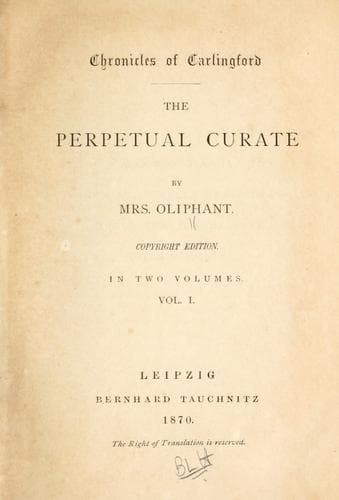
Clergy -- Fiction; England -- Social life and customs -- 19th century -- Fiction
And then he paused to think what he was to do. To go out and face the
slander which must already have crept forth on its way--to see
Elsworthy and ascertain whether he had come to his senses, and try if
anything could be done for Rosa's discovery--to exert himself somehow,
in short, and get rid of the feverish activity which he felt consuming
him,--that was what he longed to do. But, on the other hand, it was
Saturday, and Mr Wentworth was conscious that it would be more
dignified, and in better taste altogether, if he went on writing his
sermon and took no notice of this occurrence, with which, in reality,
he had nothing to do. It was difficult, but no doubt it was the best;
and he tried it accordingly--putting down a great many sentences which
had to be scratched out again, and spoiling altogether the appearance
of the sermon-paper. When a message came from Mr Wodehouse's about
eleven o'clock, bringing the news that he was much worse and not
expected to live, and begging Mr Wentworth's immediate presence, the
Curate was as nearly glad as it was possible for a man to be under the
circumstances. He had "a feeling heart," as even Elsworthy allowed,
but in such a moment of excitement any kind of great and terrible
event seemed to come natural. He hastened out into the fresh morning
sunshine, which still seemed thrilling with life and joy, and went up
Grange Lane with a certain sense of curiosity, wondering whether
everybody was already aware of what had happened. A long way off a
figure which much resembled that of the Rector was visible crossing
over to Dr Marjoribanks's door; and it occurred to the Curate that Mr
Morgan was crossing to avoid him, which brought a smile of anger and
involuntary dislike to his face, and nerved him for any other
encounter. The green door at Mr Wodehouse's--a homely sign of the
trouble in the house--had been left unlatched, and was swinging ajar
with the wind when the Curate came up; and as he went in (closing it
carefully after him, for that forlorn little touch of carelessness
went to his heart), he encountered in the garden Dr Marjoribanks and
Dr Rider, who were coming out together with very grave looks. They did
not stop for much conversation, only pausing to tell him that the case
was hopeless, and that the patient could not possibly live beyond a
day or two at most; but even in the few words that were spoken Mr
Wentworth perceived, or thought he perceived, that something had
occurred to lessen him in the esteem of the shrewd old Scotch doctor,
who contemplated him and his prayer-book with critical eyes. "I
confess, after all, that there are cases in which written prayers are
a kind of security," Dr Marjoribanks said in an irrelevant manner to
Dr Rider when Mr Wentworth had passed them--an observation at which,
in ordinary cases, the Curate would have smiled; but to-day the colour
rose to his face, and he understood that Dr Marjoribanks did not think
him qualified to carry comfort or instruction to a sick-bed.
Public-domain text, read in full here on John Shaqi.
Reviews
Reviews
No reviews yet
Be the first to share your thoughts on this work.
Elsewhere in the archive
Join the Discussion
Join the discussion
Sign in to leave a comment or review.
Sign InorCreate an account