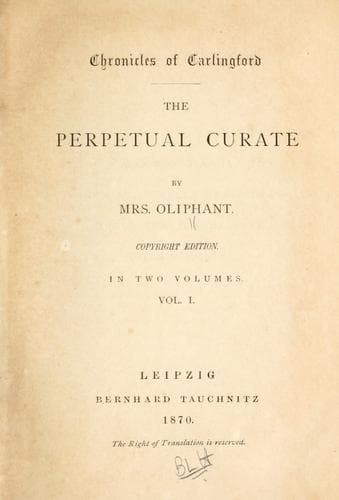
Clergy -- Fiction; England -- Social life and customs -- 19th century -- Fiction
stealthy housemaid, who contemplated herself and her new mourning for an
hour at a stretch in the great mirror without any interruption, while
she made "tidy" the furniture which nobody now disturbed. Into this
sombre apartment Miss Wodehouse came gliding, like a gentle ghost, in
her black gown. She too, like John and the housemaid and everybody
about, walked and talked under her breath. There was now no man in the
house entitled to disturb those proprieties with which a female
household naturally hedges round all the great incidents of life; and
the affairs of the family were all carried on in a whisper, in
accordance with the solemnity of the occasion--a circumstance which had
naturally called the ghost of a smile to the Curate's countenance as he
followed John up-stairs. Miss Wodehouse herself, though she was pale,
and spent half her time, poor soul! in weeping, and had, besides, living
encumbrances to trouble her helpless path, did not look amiss in her
black gown. She came in gliding without any noise, but with a little
expectation in her gentle countenance. She was one of the people whom
experience never makes any wiser; and she could not help hoping to be
delivered from her troubles this time, as so often before, as soon as
she should have transferred them to somebody else's shoulders, and taken
"advice."
"Lucy has made up her mind that we are to go to-morrow," said Miss
Wodehouse, drying her tears. "It was not the custom in my young days,
Mr Wentworth, and I am sure I don't know what to say; but I can't bear
to cross her, now that she has nobody but me. She was always the best
child in the world," said the poor lady--"far more comfort to poor
dear papa than I ever could be; but to hear her talk you would think
that she had never done anything. And oh, Mr Wentworth, if that was
all I should not mind; but we have always kept things a secret from
her; and now I have had a letter, and I don't know what it is possible
to do."
"A letter from your brother?" asked Mr Wentworth, eagerly.
"From Tom," said the elder sister; "poor, poor Tom! I am sure papa
forgave him at the last, though he did not say anything. Oh, Mr
Wentworth, he was such a nice boy once; and if Lucy only knew, and I
could summon up the courage to tell her, and he would change his ways,
as he promised--don't think me fickle or changeable, or look as if I
didn't know my own mind," cried poor Miss Wodehouse, with a fresh flow
of tears; "but oh, Mr Wentworth, if he only would change his ways, as
he promised, think what a comfort it would be to us to have him at
home!"
"Yes," said the Curate, with a little bitterness. Here was another
instance of the impunities of wickedness. "I think it very likely
indeed that you will have him at home," said Mr Wentworth--"almost
certain; the wonder is that he went away. Will you tell me where he
dates his letter from? I have a curiosity to know."
Public-domain text, read in full here on John Shaqi.
Reviews
Reviews
No reviews yet
Be the first to share your thoughts on this work.
Elsewhere in the archive
Join the Discussion
Join the discussion
Sign in to leave a comment or review.
Sign InorCreate an account