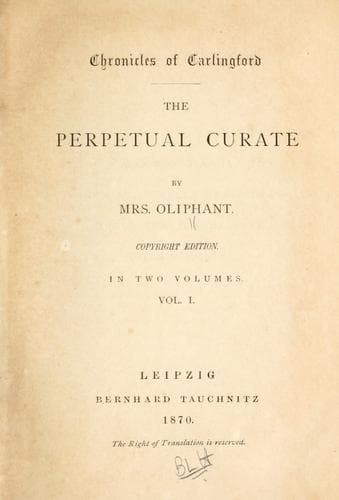
Clergy -- Fiction; England -- Social life and customs -- 19th century -- Fiction
Mr Proctor had listened only to the first words; he kept moving
uneasily in his seat while the Curate spoke. Then he broke in, "It
appears I cannot see Miss Wodehouse," he said, with an injured tone;
"she does not see any one. I cannot ask for any explanation; but it
seems to me most extraordinary. It is three months since Easter. If he
had been living with you all the time, there must have been some
occasion for it. I don't know what to think, for my part; and yet I
always imagined that I was considered a friend of the family," said
the late Rector, with an aggrieved look. He took his glass of claret
very slowly, looking at it as if expecting to see in the purple
reflection some explanation of the mystery. As for Gerald Wentworth,
he relapsed into silence when he found that his arguments did not
alter Frank's decision; he too was disappointed not to find his
brother alone. He sat with his eyes cast down, and a singular look of
abstraction on his face. He had got into a new atmosphere--a different
world. When his anxieties about Frank were satisfied, Gerald withdrew
himself altogether from the little party. He sat there, it is true,
not unaware of what was going on, and even from time to time joining
in the conversation; but already a subtle change had come over Gerald.
He might have been repeating an "office," or carrying on a course of
private devotions, from his looks. Rome had established her dualism in
his mind. He had no longer the unity of an Englishman trained to do
one thing at a time, and to do it with his might. He sat in a kind of
languor, carrying on within himself a thread of thought, to which his
external occupation gave no clue; yet at the same time suffering no
indication to escape him of the real condition of his mind. The three
were consequently far from being good company. Mr Proctor, who was
more puzzled than ever as to the true state of the case, could not
unburden himself of his own intentions as he had hoped to do; and
after a while the Curate, too, was silent, finding his statements
received, as he thought, but coldly. It was a great relief to him when
he was called out by Sarah to speak to some one, though his absence
made conversation still more difficult for the two who were left
behind. Mr Proctor, from the other side of the table, regarded Gerald
with a mixture of wonder and pity. He did not feel quite sure that it
was not his duty to speak to him--to expound the superior catholicity
of the Church of England, and call his attention to the schismatic
peculiarities of the Church of Rome. "It might do him good to read
Burgon's book," Mr Proctor said to himself; and by way of introducing
that subject, he began to talk of Italy, which was not a bad device,
and did credit to his invention. Meanwhile the Curate had gone to his
study, wondering a little who could want him, and, to his utter
bewilderment, found his aunt Dora, veiled, and wrapped up in a great
shawl.
Public-domain text, read in full here on John Shaqi.
Reviews
Reviews
No reviews yet
Be the first to share your thoughts on this work.
Elsewhere in the archive
Join the Discussion
Join the discussion
Sign in to leave a comment or review.
Sign InorCreate an account