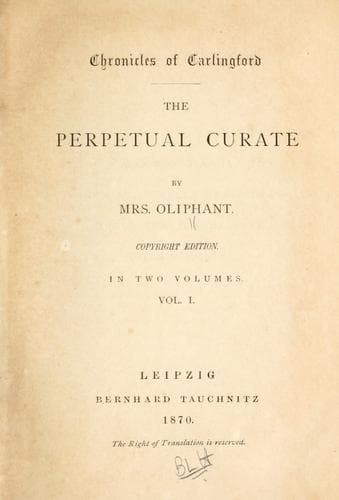
Clergy -- Fiction; England -- Social life and customs -- 19th century -- Fiction
"Sir," said Elsworthy, "he come into my shop as regular as the day; he
never come but he asked after Rosa, or spoke to her if she was there.
One night he walked all the way up Grange Lane and knocked at my door
and brought her in all of a glow, and said I wasn't to send her out
late no more. My missis, being a woman as is very particular, was
struck, and thought as harm might come of it; and, not to be talked
of, we sent Rosa away. And what does Mr Wentworth do, but the moment
he hears of it comes right off to my shop! He had been at his own
home, sir, a-visiting his respected family," said Elsworthy, turning
slightly towards the side of the room where the father and sons sat
together. "He came to my shop with his carpet-bag as he come off the
railway, and he gave me my orders as I was to bring Rosa back. What he
said was, 'Directly,' that very day. I never had no thought but what
his meaning was honourable--being a clergyman," said the witness, with
a heavy sigh; and then there ensued a little pause.
"The Miss Hemmings had better be called now," said Mr Waters.
"Elsworthy, you can retire; but we may require you again, so you had
better not go away. Request Miss Hemmings to do us the favour of
coming here."
The Squire lifted his heavy eyes when the next witness entered. She
made a very solemn curtsy to the gentlemen, and sat down on the chair
which somebody placed for her. Being unsupported, a lady--not to say
an unmarried lady profoundly conscious of the fact--among a number of
men, Miss Hemmings was naturally much agitated. She was the eldest and
the softest-hearted; and it occurred to her for the first time, as she
gave a frightened look towards the Curate, that he was like her
favourite younger brother, who had died ever so many years ago--a
thought which, for the first time, made her doubtful of her testimony,
and disposed to break down in her evidence.
"You were in Grange Lane on the evening of the 15th ultimo," said Mr
Morgan, after he had carefully written down her name, "about nine
o'clock?"
"Oh yes, Mr Morgan," said the poor lady; "we were at St Roque's
Cottage drinking tea with Mrs Bland, who was lodging with Mrs Smith in
the same rooms Mrs Rider used to have. I put the note of invitation in
my pocket in case there should be any doubt; but, indeed, poor Mrs
Bland was taken very ill on the 16th, and Dr Marjoribanks was called,
and he knows it could not be any other evening--and besides--"
"About nine o'clock," said Mr Waters; "did I understand you, it was
about nine o'clock?"
"She was such an invalid, poor dear," said Miss Hemmings,
apologetically; "and it is such a privilege to have real Christian
conversation. We dined early on purpose, and we were asked for
half-past six. I think it must have been a little after nine; but Mary
is here, and she knows what hour she came for us. Shall I call Mary,
please?"
Public-domain text, read in full here on John Shaqi.
Reviews
Reviews
No reviews yet
Be the first to share your thoughts on this work.
Elsewhere in the archive
Join the Discussion
Join the discussion
Sign in to leave a comment or review.
Sign InorCreate an account