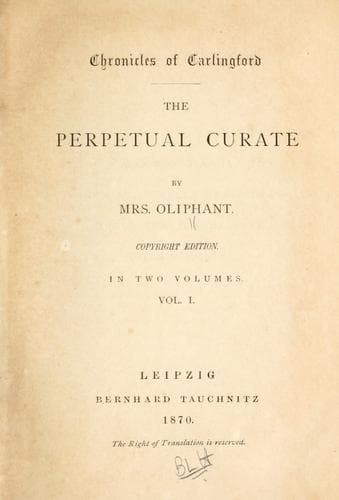
Clergy -- Fiction; England -- Social life and customs -- 19th century -- Fiction
The conclusion of this letter gave Lucy a good deal of trouble. Her
honest heart was so moved with gratitude and admiration that she had
nearly called herself "affectionately" Mr Wentworth's. Why should not
she? "He has acted like a brother to us," Lucy said to herself; and
then she paused to inquire whether his conduct had indeed arisen from
brotherly motives solely. Then, when she had begun to write
"faithfully" instead, a further difficulty occurred to her. Not thus
lightly and unsolicited could she call herself "faithful," for did not
the word mean everything that words could convey in any human
relationship? When she had concluded it at last, and satisfied her
scruples by the formula above, she laid the letter before her sister.
This event terminated the active operations of the day in the dwelling
of the Wodehouses. Their brother had not asked to see them, had not
interrupted them as yet in their retreat up-stairs, where they were
sedulously waited upon by the entire household. When Miss Wodehouse's
agitation was over, she too began to collect together her books and
personalities, and they ended by a long consultation where they were
to go and what they were to do, during the course of which the elder
sister exhibited with a certain shy pride that little photograph of
the new rectory, in which there was one window embowered in foliage,
which the bride had already concluded was to be Lucy's room. Lucy
yielded during this sisterly conference to sympathetic thoughts even
of Mr Proctor. The two women were alone in the world. They were still
so near the grave and the deathbed that chance words spoken without
thought from time to time awakened in both the ready tears. Now and
then they each paused to consider with a sob what _he_ would have
liked best. They knew very little of what was going on outside at the
moment when they were occupied with those simple calculations. What
was to become of them, as people say--what money they were to have, or
means of living--neither was much occupied in thinking of. They had
each other; they had, besides, one a novel and timid middle-aged
confidence, the other an illimitable youthful faith in one man in the
world. Even Lucy, whose mind and thoughts were more individual than
her sister's, wanted little else at that moment to make her happy with
a tender tremulous consolation in the midst of her grief.
CHAPTER XXXVIII.
Public-domain text, read in full here on John Shaqi.
Reviews
Reviews
No reviews yet
Be the first to share your thoughts on this work.
Elsewhere in the archive
Join the Discussion
Join the discussion
Sign in to leave a comment or review.
Sign InorCreate an account