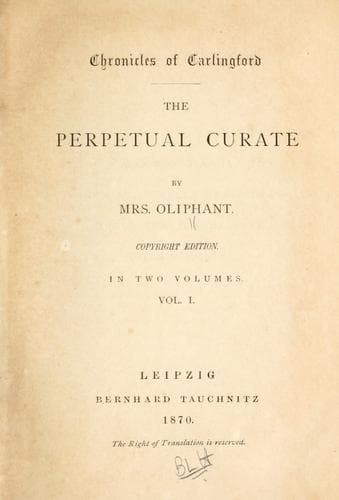
Clergy -- Fiction; England -- Social life and customs -- 19th century -- Fiction
The eldest son roused himself up at the mention of his own name.
Notwithstanding all his faults, he was not a man to stand behind backs
and listen to what was said of him. He came forward with his usual
ease, though a close observer might have detected a flush on his face.
"I am here, sir," said the heir. "I cannot flatter myself you will
have much pleasure in seeing me; but I suppose I have still a right to
be considered one of the family." The Squire, who had risen to his
feet, and was standing leaning against the table when Jack advanced,
returned to his chair and sat down as his eldest son confronted him.
They had not met for years, and the shock was great. Mr Wentworth put
his hand to his cravat and pulled at it with an instinctive movement.
The old man was still feeble from his late illness, and apprehensive
of a return of the disease of the Wentworths. He restrained himself,
however, with force so passionate that Jack did not guess at the
meaning of the gasp which, before the Squire was able to speak to him,
convulsed his throat, and made Frank start forward to offer assistance
which his father impatiently rejected. The Squire made, indeed, a
great effort to speak with dignity. He looked from one to another of
his tall sons as he propped himself up by the arms of his chair.
"You are the most important member of the family," said Mr Wentworth;
"it is long since you have been among us, but that is not our fault.
If things had been different, I should have been glad of your advice
as a man of the world. Anyhow, I can't wish you to be estranged from
your brothers," said the Squire. It was all any one could say. The
heir of Wentworth was not to be denounced or insulted among his
kindred, but he could not be taken to their bosom. Perhaps the
reception thus given him was more galling than any other could have
been to Jack Wentworth's pride. He stood at the table by himself
before his father, feeling that there existed no living relations
between himself and any one present. He had keen intellectual
perceptions, and could recognise the beauty of honour and worth as
well as most people; and the contrast between himself and the others
who surrounded him presented itself in a very forcible light to Jack.
Instead of Gerald and Frank, Wodehouse was _his_ allotted companion.
For that once he was bitter, notwithstanding his habitual good-humour.
"Yes," he said; "it would be a pity to estrange me from my brothers.
We are, on the whole, a lucky trio. I, whom my relations are civil to;
and Frank, who is not acquitted yet, though he seems so confident; and
Gerald, who has made the greatest mistake of all--"
"Jack," said the Curate, "nobody wants to quarrel with you. You've
dealt shabbily by me, but I do not mind. Only talk of things you
understand--don't talk of Gerald."
Public-domain text, read in full here on John Shaqi.
Reviews
Reviews
No reviews yet
Be the first to share your thoughts on this work.
Elsewhere in the archive
Join the Discussion
Join the discussion
Sign in to leave a comment or review.
Sign InorCreate an account