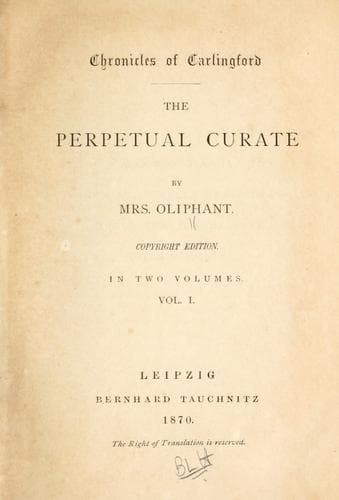
Clergy -- Fiction; England -- Social life and customs -- 19th century -- Fiction
"It is all true enough that she says," said Mr Wentworth. "She mayn't
understand _him_, Frank, but she's right enough in what she's saying.
If things were different between your brother and me, I'd ask his
advice," said the Squire, with a sigh. He gave a longing look at his
eldest son, who stood with his usual ease before the fireplace.
Matters had gone a great deal too far between the father and son to
admit of the usual displeasure of an aggrieved parent--all that was
over long ago; and Mr Wentworth could not restrain a certain melting
of the heart towards his first-born. "He's not what I could wish, but
he's a man of the world, and might give us some practical advice,"
said the Squire, with his anxious looks. Of what possible advantage
advice, practical or otherwise, could have been in the circumstances,
it was difficult to see; but the Squire was a man of simple mind, and
still believed in the suggestions of wisdom. He still sat in the
easy-chair, looking wistfully at Jack, and with a certain faith that
matters might even yet be mended, if the counsel of his eldest son, as
a man of the world, could be had and could be trusted; when Frank, who
had an afternoon service at Wharfside, had to leave the family
committee. Gerald, who roused up when his younger brother mentioned
the business he was going upon, looked at Frank almost as wistfully as
his father looked at Jack. "It may be the last time," he said to
himself; "if you'll let me, I'll go with you, Frank;" and so the
little conclave was broken up. The people in Prickett's Lane were
greatly impressed by the aspect of Gerald Wentworth, as he went,
silent and pale, by his brother's side, down the crowded pavement.
They thought it must be a bishop at least who accompanied the Curate
of St Roque's; and the women gathered at a little distance and made
their comments, as he stood waiting for his brother after the service.
"He don't look weakly nor sickly no more nor the clergyman," said one;
"but he smiles at the little uns for all the world like my man smiled
the night he was took away." "Smilin' or not smilin'," said another,
"I don't see as it makes no matter; but I'd give a deal to know what
Elsworthy and them as stands by Elsworthy can say after that." "Maybe,
then, he'd give the poor fatherless children a blessing afore he'd
go," suggested a poor Irish widow, who, having been much under Mr
Wentworth's hands "in her trouble," was not quite sure now what faith
she professed, or at least which Church she belonged to. Such was the
universal sentiment of Prickett's Lane. Meanwhile Gerald stood silent,
and looked with pathetic, speechless eyes at the little crowd. He was
no priest now--he was shorn of the profession which had been his life.
His hope of being able to resign all things for Christ's sake had
failed him. Too wary and politic to maintain in a critical age and
country the old licence of the ages of Faith, even his wife's consent,
Public-domain text, read in full here on John Shaqi.
Reviews
Reviews
No reviews yet
Be the first to share your thoughts on this work.
Elsewhere in the archive
Join the Discussion
Join the discussion
Sign in to leave a comment or review.
Sign InorCreate an account