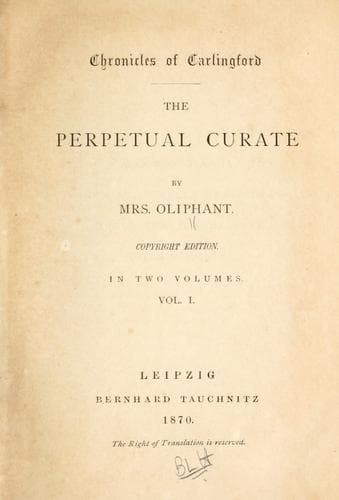
Clergy -- Fiction; England -- Social life and customs -- 19th century -- Fiction
any means so certain as, judging from her character, it ought to have
been, that duty would have won the day.
CHAPTER XLII.
Frank Wentworth once more went up Grange Lane, a thoughtful and a sober
man. Exhilaration comes but by moments in the happiest of lives--and
already he began to remember how very little he had to be elated about,
and how entirely things remained as before. Even Lucy; her letter very
probably might be only an effusion of friendship; and at all events,
what could he say to her--what did he dare in honour say? And then his
mind went off to think of the two rectories, between which he had fallen
as between two stools: though he had made up his mind to accept neither,
he did not the less feel a certain mortification in seeing that his
relations on both sides were so willing to bestow their gifts elsewhere.
He could not tolerate the idea of succeeding Gerald in his own person,
but still he found it very disagreeable to consent to the thought that
Huxtable should replace him--Huxtable, who was a good fellow enough, but
of whom Frank Wentworth thought, as men generally think of their
brothers-in-law, with a half-impatient, half-contemptuous wonder what
Mary could ever have seen in so commonplace a man. To think of him as
rector of Wentworth inwardly chafed the spirit of the Perpetual Curate.
As he was going along, absorbed in his own thoughts, he did not
perceive how his approach was watched for from the other side of the way
by Elsworthy, who stood with his bundle of newspapers under his arm and
his hat in his hand, watching for "his clergyman" with submission and
apology on the surface, and hidden rancour underneath. Elsworthy was not
penitent; he was furious and disappointed. His mistake and its
consequences were wholly humiliating, and had not in them a single
saving feature to atone for the wounds of his self-esteem. The Curate
had not only baffled and beaten him, but humbled him in his own eyes,
which is perhaps, of all others, the injury least easy to forgive. It
was, however, with an appearance of the profoundest submission that he
stood awaiting the approach of the man he had tried so much to injure.
"Mr Wentworth, sir," said Elsworthy, "if I was worth your while, I
might think as you were offended with me; but seeing I'm one as is so
far beneath you"--he went on with a kind of grin, intended to
represent a deprecatory smile, but which would have been a snarl had
he dared--"I can't think as you'll bear no malice. May I ask, sir, if
there's a-going to be any difference made?"
"In what respect, Elsworthy?" said the Curate, shortly.
Public-domain text, read in full here on John Shaqi.
Reviews
Reviews
No reviews yet
Be the first to share your thoughts on this work.
Elsewhere in the archive
Join the Discussion
Join the discussion
Sign in to leave a comment or review.
Sign InorCreate an account