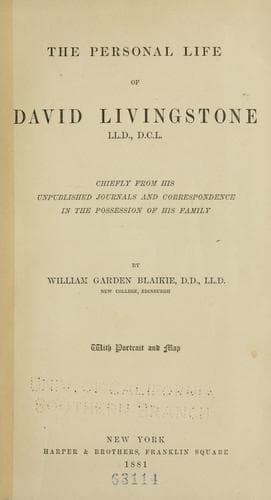
The Personal Life of David Livingstone: Chiefly from his Unpublished Journals and Correspondence in the Possession of His FamilyBlaikie, William Garden
Religion
The Personal Life of David Livingstone: Chiefly from his Unpublished Journals and Correspondence in the Possession of His Family
Blaikie, William Garden
Livingstone, David, 1813-1873
The third, and at last successful, effort to reach Sebituane was made in
April, 1851. Livingstone was again accompanied by his family, and by Mr.
Oswell. He left Kolobeng with the intention not to return, at least not
immediately, but to settle with his family in such a spot as might be
found advantageous, in the hilly region, of whose existence he was
assured. They found the desert drier than ever, no rain having fallen
throughout an immense extent of territory. To the kindness of Mr. Oswell
the party was indebted for most valuable assistance in procuring water,
wells having been dug or cleared by his people beforehand at various
places, and at one place at the hazard of Mr. Oswell's life, under an
attack from an infuriated lioness. In his private Journal, and in his
letters to home, Livingstone again and again acknowledges with deepest
gratitude the numberless acts of kindness done by Mr. Oswell to him and
his family, and often adds the prayer that God would reward him, and of
His grace give him the highest of all blessings. "Though I cannot repay,
I may record with gratitude his kindness, so that, if spared to look
upon these, my private memoranda, in future years, proper emotions may
ascend to Him who inclined his heart to show so much friendship."
The party followed the old route, around the bed of the Zouga, then
crossed a piece of the driest desert they had ever seen, with not an
insect or a bird to break the stillness. On the third day a bird chirped
in a bush, when the dog began to bark! Shobo, their guide, a Bushman,
lost his way, and for four days they were absolutely without water. In
his _Missionary Travels_, Livingstone records quietly, as was his wont
his terrible anxiety about his children.
"The supply of water in the wagons had been wasted by one of
our servants, and by the afternoon only a small portion
remained for the children. This was a bitterly anxious night;
and next morning, the less there was of water, the more
thirsty the little rogues became. The idea of their perishing
before our eyes was terrible; it would almost have been a
relief to me to have been reproached with being the entire
cause of the catastrophe, but not one syllable of upbraiding
was uttered by their mother, though the tearful eye told the
agony within. In the afternoon of the fifth day, to our
inexpressible relief, some of the men returned with a supply
of that fluid of which we had never before felt the
true value."
"No one," he remarks in his Journal, "knows the value of
water till be is deprived of it. We never need any spirits to
qualify it, or prevent an immense draught of it from doing us
harm. I have drunk water swarming with insects, thick with
mud, putrid from other mixtures, and no stinted draughts of
it either, yet never felt any inconvenience from it."
Public-domain text, read in full here on John Shaqi.
Reviews
Reviews
No reviews yet
Be the first to share your thoughts on this work.
Elsewhere in the archive
Join the Discussion
Join the discussion
Sign in to leave a comment or review.
Sign InorCreate an account