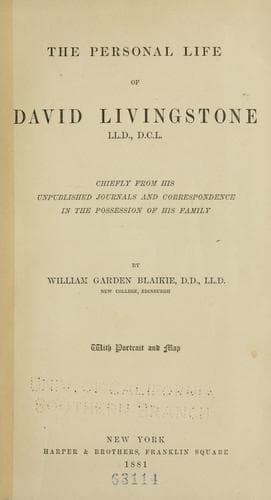
The Personal Life of David Livingstone: Chiefly from his Unpublished Journals and Correspondence in the Possession of His FamilyBlaikie, William Garden
Religion
The Personal Life of David Livingstone: Chiefly from his Unpublished Journals and Correspondence in the Possession of His Family
Blaikie, William Garden
Livingstone, David, 1813-1873
Setting out with the wagons on 13th August, 1851, the party proceeded
slowly homeward. On 15th September, 1851, Livingstone's Journal has this
unexpected and simple entry: "A son, William Oswell Livingstone[32],
born at a place we always call Bellevue." On the 18th: "Thomas attacked
by fever; removed to a high part on his account. Thomas was seized with
fever three times at about an interval of a fortnight." Not a word about
Mrs. Livingstone, but three pages of observations about medical
treatment of fever, thunderstorms, constitutions of Indian and African
people, leanness of the game, letter received from Directors approving
generally of his course, a gold watch sent by Captain Steele, and Gordon
Cumming's book, "a miserably poor thing." Amazed, we ask, Had
Livingstone any heart? But ere long we come upon a copy of a letter, and
some remarks connected with it, that give us an impression of the depth
and strength of his nature, unsurpassed by anything that has
yet occurred.
[Footnote 32: He had intended to call him Charles, and announced this to
his father; but, finding that Mr. Oswell, to whom he was so much
indebted, would be pleased with the compliment, he changed his purpose
and the name accordingly.]
"The following extracts," he says, "show in what light our efforts are
regarded by those who, as much as we do, desire that the 'gospel may be
preached to all nations,'" Then follows a copy of a letter which had
been addressed to him before they set out by Mrs. Moffat, his
mother-in-law, remonstrating in the strongest terms against his plan of
taking his wife with him; reminding him of the death of the child, and
other sad occurrences of last year; and in the name of everything that
was just, kind, and even decent, beseeching him to abandon an
arrangement which all the world would condemn. Another letter from the
same writer informed him that much prayer had been offered that, if the
arrangements were not in accordance with Christian propriety, he might
in great mercy be prevented by some dispensation of Providence from
carrying them out. Mrs. Moffat was a woman of the highest gifts and
character, and full of admiration for Livingstone. The insertion of
these letters in his Journal shows that, in carrying out his plan, the
objections to which it was liable were before his mind in the strongest
conceivable form. No man who knows what Livingstone was will imagine for
a moment that he had not the most tender regard for the health, the
comfort, and the feelings of his wife; in matters of delicacy he had the
most scrupulous regard to propriety; his resolution to take her with him
must, therefore, have sprung from something far stronger than even his
affection for her. What was this stronger force?
Public-domain text, read in full here on John Shaqi.
Reviews
Reviews
No reviews yet
Be the first to share your thoughts on this work.
Elsewhere in the archive
Join the Discussion
Join the discussion
Sign in to leave a comment or review.
Sign InorCreate an account