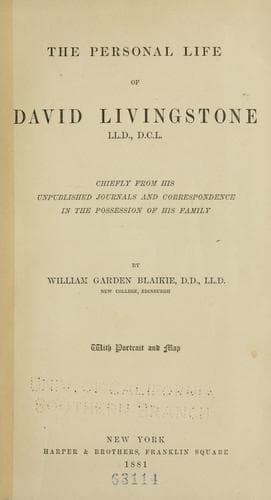
The Personal Life of David Livingstone: Chiefly from his Unpublished Journals and Correspondence in the Possession of His FamilyBlaikie, William Garden
Religion
The Personal Life of David Livingstone: Chiefly from his Unpublished Journals and Correspondence in the Possession of His Family
Blaikie, William Garden
Livingstone, David, 1813-1873
May He forgive, and purify, and bless us."
If in his spirit of high consecration he was thus unchanged, equally far
was he from having a fanatical disregard of life, and the rules of
provident living.
"Jesus," he says, "came not to judge,--[Greek:
kriuo],--condemn judicially, or execute vengeance on any one.
His was a message of peace and love. He shall not strive nor
cry, neither shall his voice he heard in the streets.
Missionaries ought to follow his example. Neither insist on
our rights, nor appear as if we could allow our goods to be
destroyed without regret: for if we are righteous overmuch,
or stand up for our rights with too much vehemence, we beget
dislikes, and the people see no difference between ourselves
and them. And if we appear to care nothing for the things of
this world, they conclude we are rich, and when they beg, our
refusal is ascribed to niggardliness, and our property, too,
is wantonly destroyed. 'Ga ba tloke'=they are not in need, is
the phrase employed when our goods are allowed to go to
destruction by the neglect of servants.... In coming among
savage people, we ought to make them feel we are of them, 'we
seek not yours, but you'; but while very careful not to make
a gain of them, we ought to be as careful to appear thankful,
and appreciate any effort they may make for our comfort or
subsistence."
On reaching Kolobeng from 'Ngami they found the station deserted. The
Bakwains had removed to Limaüe. Sechéle came down the day after, and
presented them with an ox--a valuable gift in his circumstances. Sechéle
had much yet to bear from the Boers; and after being, without
provocation, attacked, pillaged, and wasted, and robbed of his children,
he was bent on going to the Queen of England to state his wrongs. This,
however, he could not accomplish, though he went as far as the Cape.
Coming back afterward to his own people, he gathered large numbers about
him from other tribes, to whose improvement he devoted himself with much
success. He still survives, with the one wife whom he retained; and,
though not without some drawbacks (which Livingstone ascribed to the bad
example set him by some), he maintains his Christian profession. His
people are settled at some miles' distance from Kolobeng, and have a
missionary station, supported by a Hanoverian Society. His regard for
the memory of Livingstone is very great, and he reads with eagerness all
that he can find about him. He has ever been a warm friend of missions
has a wonderful knowledge of the Bible, and can preach well. The
influence of Livingstone in his early days was doubtless a real power in
mission-work. Mebalwe, too, we are informed by Dr. Moffat, still
survives; a useful man, an able preacher, and one who has done much to
bring his people to Christ.
Public-domain text, read in full here on John Shaqi.
Reviews
Reviews
No reviews yet
Be the first to share your thoughts on this work.
Elsewhere in the archive
Join the Discussion
Join the discussion
Sign in to leave a comment or review.
Sign InorCreate an account